
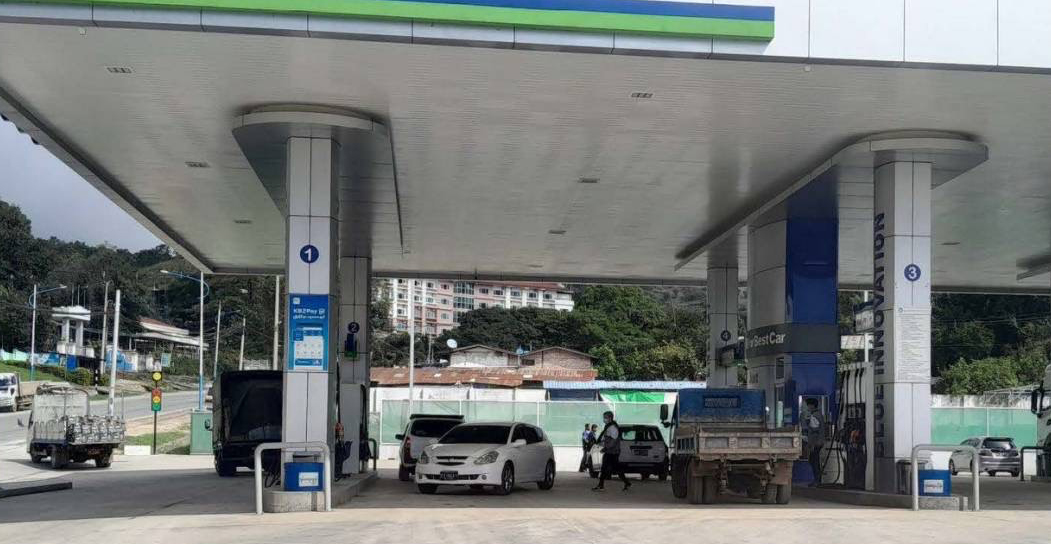
PLUMMETING global crude costs have driven domestic regulated fuel caps to a five-month low, with prices dropping by K1,360 per litre.
The reference prices set for this week ending 2 July declined to K3,615 for Octane 92, K3,695 for Octane 95, K3,535 for diesel and K4,190 for premium diesel. The reference prices set during the week ending 4 June were K4,550 for Octane 92, K4,620 for Octane 95, K4,595 for diesel and K5,550 for premium diesel. The figures showed a sharp drop in the amount of K925 to K1,360 per litre.
The exchange rate between the Myanmar kyat and the US dollar weighs on the fuel price. The price index set by Mean of Platts Singapore (MOPS), the pricing basis for many refined products in Southeast Asia, influences the domestic fuel prices, according to the Supervisory Committee on Oil Import, Storage and Distribution of Fuel Oil.
The committee is governing the market to ensure a stable price and secure supply. Under the guidance of the Supervisory Committee, the Petroleum Products Regulatory Department has been issuing daily reference wholesale prices to ensure price stability for energy consumers.
The committee is inspecting the fuel stations to see whether they are overcharging. Authorities are taking action against those retailers of fuel stations under the Petroleum and Petroleum Products Law 2017 if they are found overcharging rather than the set reference rate.
As per the statement, 90 per cent of fuel oil in Myanmar is imported, while the remaining 10 per cent is produced locally. Domestic fuel prices are highly correlated with international prices. The State is steering the market to mitigate the loss experienced by importers, sellers and energy consumers. Consequently, the government is trying to distribute the oil at a reasonable price compared to those of regional countries.
Some countries levied higher tax rates and hiked oil prices than Myanmar’s. However, Malaysia’s oil sector receives government subsidies, and the prices are about 60 per cent lower than those of Myanmar. Every country lays down different policy patterns to fix oil prices, the Supervisory Committee on Oil Import, Storage and Distribution of Fuel Oil stated. — NN/KK