
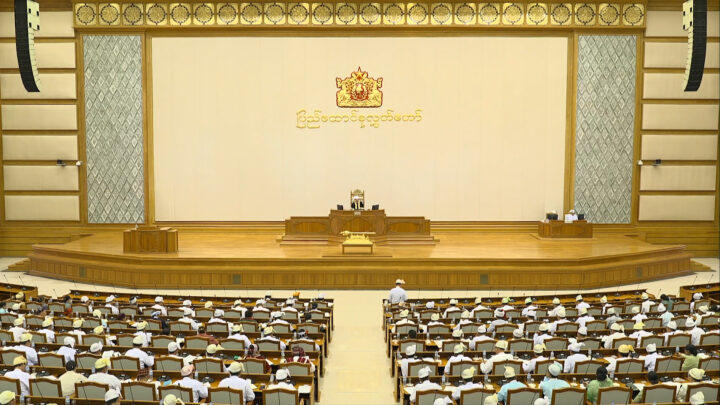
Hluttaw Debates Overhaul of ASEAN Five-Point Statement
The second regular session of the Third Pyidaungsu Hluttaw continued for the fourth day at its convention hall in Nay Pyi Taw yesterday morning, attended by Pyidaungsu Hluttaw Speaker U Aung Lin Dwe, Pyithu Hluttaw Speaker U Khin Yi, Pyithu Hluttaw Deputy Speaker U Maung Maung Ohn, Amyotha Hluttaw Deputy Speaker Jeng Phang Naw Taung and Hluttaw representatives.
At the Hluttaw session, Dr Nanda Hla Myint from the Kalaw Constituency submitted a motion, urging the Union government to review the ASEAN Five-Point Statement, which undermines Myanmar’s equality within ASEAN and is inconsistent with ASEAN’s fundamental principle of non-interference in the internal affairs of a member state in addition to the non-alignment with ASEAN’s fundamental principles and Myanmar’s current actual political situation.
He said that since its membership to date, Myanmar signed the ASEAN Charter as a responsible member state, and has been actively adhering to and implementing the fundamental principles set out in the Charter in order to promote regional peace, stability, development, and cooperation.
He added that ASEAN and its member states have further reaffirmed and agreed that, in implementing the objectives of the ASEAN Charter, they must adhere to the principles contained in ASEAN declarations, treaties, conventions, agreements, and other legal instruments.
He continued that due to electoral fraud in the 2020 general election, a state of emergency was declared nationwide in February 2021 under the Constitution, and the three branches of state power were assumed by Tatmadaw in accordance with the 2008 Constitution. About Myanmar’s situation, during the period when the State Administration Council assumed national responsibilities with a view to national politics, most countries in the United Nations imposed sanctions on Myanmar, and the ASEAN community likewise exerted pressure on Myanmar. ASEAN is an organization honoured worldwide for establishing and maintaining good traditions among regional countries in the political, security, economic, social, and cultural sectors. However, at a time when strategic competition in the region has increased, ASEAN, instead of upholding its long-standing tradition of unity in diversity and its spirit of consensus on shared values, has been applying pressure on Myanmar.
The representative recounted that on 24 April 2021, following the ASEAN Leaders’ Meeting held in Jakarta, Indonesia, ASEAN issued the “Five-Point Consensus” as an annex to the Chairman’s Statement. These were: immediate cessation of violence; constructive dialogue to seek a peaceful solution; a Special Envoy of ASEAN will facilitate mediation of the dialogue process; ASEAN shall provide humanitarian assistance; and the Special Envoy shall visit Myanmar to meet with all parties concerned.
He noted that although these five points are referred to as a “Five-Point Consensus” in the Chairman’s Statement, they were not an ASEAN statement that was first circulated as a draft to all ASEAN Member States and issued only after reaching collective agreement. Rather, they were issued as an annex to the ASEAN Chair’s Statement. It is also observed that Myanmar responded by informing that it would only implement the statement in accordance with its own political culture and within the ASEAN framework.
He stated that the ASEAN Five-Point Statement was made with the positive intention of helping to resolve armed conflicts in Myanmar and to achieve internal peace. However, it is not an approach based on sincerity and mutual assistance among ASEAN Member States. Rather, it is inconsistent with the fundamental principles of the ASEAN Charter and the Treaty on Amity and Cooperation in South-East Asia (TAC) signed in 1976, which include mutual respect for the independence, sovereignty, equality, territorial integrity, and national identity of all nations; the right of each state to lead its national existence free from external interference, subversion, and coercion; and the principle of non-interference in the internal affairs of other states. It is therefore observed that it deviates from ASEAN’s core principles.
At the present time, he stated that Myanmar has already held elections in accordance with the 2008 Constitution and an elected civilian government has emerged. When the ASEAN Five-Point Statement is compared with the country’s current actual situation, it is found to be inconsistent. It is also observed that ASEAN, in implementing the Five-Point Statement, is acting in line with pressure and guidance from certain Western countries, thereby weakening ASEAN centrality. Furthermore, it appears that the ASEAN Charter is being selectively interpreted and applied. Therefore, it is necessary to review the ASEAN Five-Point Statement.
He revealed that although ASEAN is committed to enhancing regional peace, security, and prosperity, and the ASEAN Charter stipulates respect for the independence, sovereignty, equality, territorial integrity, and national identity of each state, as well as collective responsibility and non-interference in the internal affairs of ASEAN Member States, some ASEAN countries are found to be unwilling to recognize the Myanmar Government.
He stressed that the exclusion of responsible heads of government from being invited and allowed to attend ASEAN meetings is inconsistent with the fundamental principles of the ASEAN Charter. In particular, it contradicts paragraph 2 (f) of Article 2 of Chapter I, which states that member states shall respect the right of every Member State to lead its national existence free from external interference, subversion and coercion. It also contradicts Article 5 of Chapter III, which provides that Member States shall have equal rights and obligations under this Charter. Such actions, including exerting pressure on Myanmar and failing to grant equal rights, are found to be inconsistent with the ASEAN Charter.
During the previous period under the State Administration Council government, there were also pressures and demands from some ASEAN Member States to implement the ASEAN Five-Point Statement. At that time, the National Defence and Security Council responded that it was cooperating without harming the country’s national interests and sovereignty, and that ASEAN does not have the authority to make decisions on or interfere in the internal affairs of a member state without the consent of the respective country.
In implementing the unilaterally issued ASEAN Five-Point Statement, Myanmar’s national interests, sovereignty, and the actual realities on the ground are carefully taken into consideration. In engaging with ASEAN, priority should be given to Myanmar’s national interests in order to further enhance regional cooperation. Increasing humanitarian assistance, confidence-building measures, and mutual dialogue can contribute to regional stability and peace. As the right of a sovereign state, it is now necessary to re-negotiate and re-engage through more practical and balanced approaches that prioritize national interests.
Nan Yi Yi Win from the Pinlaung Constituency seconded the motion.
Regarding the motion, the Speaker sought the decision of the Hluttaw, and as there were more votes in favour, it was announced that the motion was approved for discussion. He announced that any Hluttaw representatives wishing to speak could list the director-general of the Pyidaungsu Hluttaw Office.
Moreover, the Hluttaw recorded the appointment of a regional minister, the formation of the Myanmar Parliamentary Union (MPU), the Joint Committee on ASEAN Inter-Parliamentary Assembly (JCAIPA), and the Joint Committee on Inter-Parliamentary Union (JCIPU), the agreement on tax between Myanmar and Belarus, and a one-month exemption of special goods tax and the commercial tax over diesel and LNG.
Deputy Minister for Finance and Revenue U Han Win Aung said that the conclusion of the agreement on the avoidance of double taxation on income and the prevention of tax evasion will provide various benefits, including enabling businesses to avoid double taxation, thereby promoting increased investment and trade between the two countries; enhancing information exchange between tax authorities and improving tax compliance through joint efforts to prevent tax evasion; and contributing to the improvement and strengthening of diplomatic relations between the two countries.
He added that the agreement applies solely to income tax. It will affect individuals, businesses, and companies that are residents of the two countries. As the agreement includes provisions allowing the exchange of information between the tax authorities of both countries, it will enable joint efforts to prevent tax evasion. In order to bring the agreement into force, the deputy minister sought approval from the Pyidaungsu Hluttaw to transmit Myanmar’s notification letter to the Republic of Belarus in accordance with the Constitution.
He also sought the approval from the Pyidaungsu Hluttaw for the additional one-month exemption from 1 to 31 May 2026 of special goods tax and the commercial tax over diesel HSD (500 ppm).
The Speaker urged Hluttaw representatives wishing to discuss the aforesaid two issues to list with the director-general of the Pyidaungsu Hluttaw Office.
The Pyidaungsu Hluttaw adjourned its fourth-day session, and the fifth-day session will be held on 2 July. — MNA/TTA