
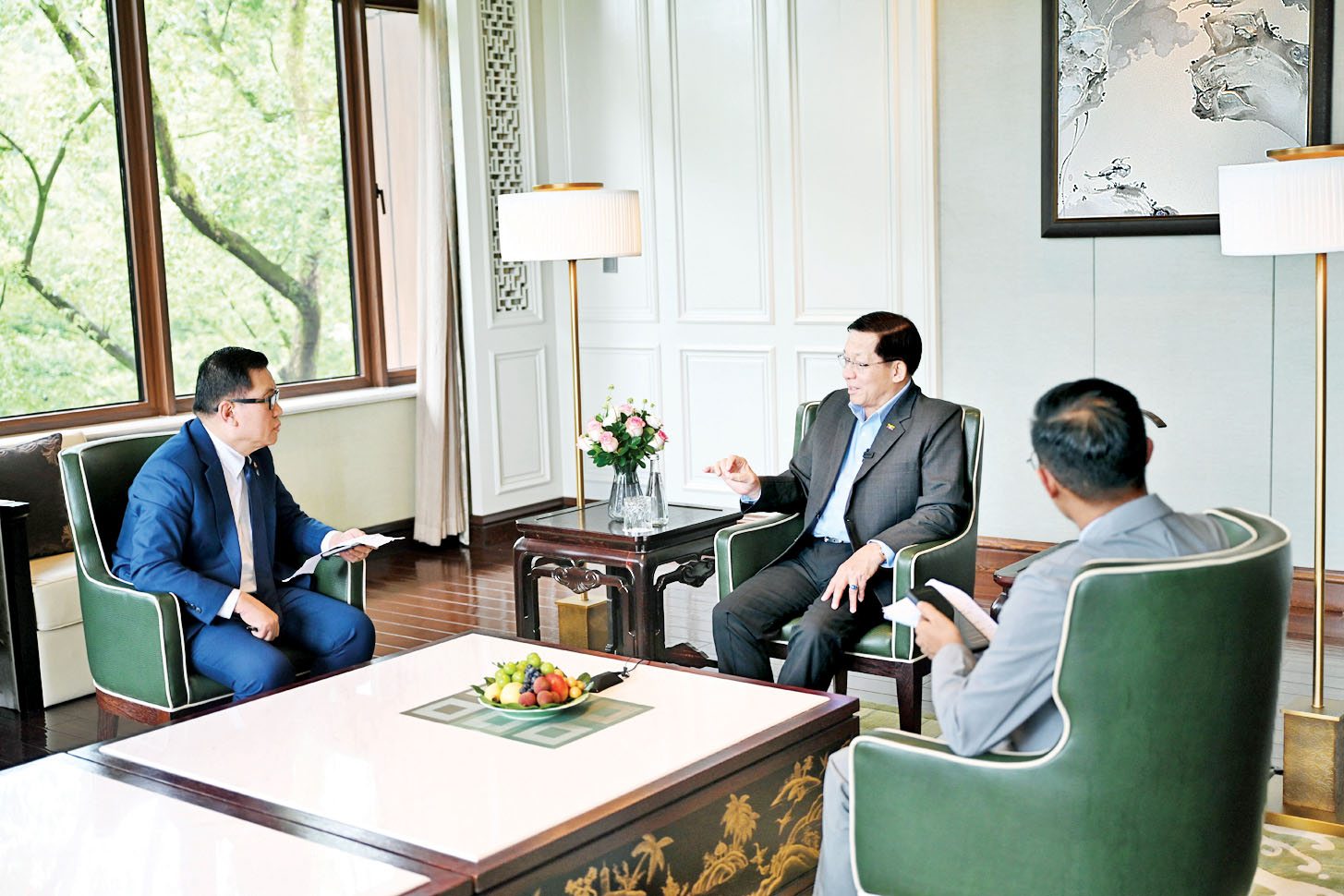
PRESIDENT of the Republic of the Union of Myanmar U Min Aung Hlaing responded to the queries raised by local media from Myanmar on his State Visit to the People’s Republic of China at the invitation of Chinese President Mr Xi Jinping. The full text of the translated interview with local media is as follows:
U Kyaw Zaw Lin, Chief Editor of Eleven Media Group: Within 100 days of assuming office as President, the President had already met the leaders of two major countries, India and now China. Before that, foreign ministers from five countries also came to Nay Pyi Taw to meet the President. According to available information, more foreign ministers and other diplomats are also expected to meet the President. In that context, how do you think this shift, from the diplomatic isolation of the past five years to the current situation, could bring positive outcomes for Myanmar and its people?
President: International diplomatic relations among countries are an important sector for the respective states. This includes diplomatic relations in general – relations between leaders, relations between governments, diplomatic engagements, and economic ties. There are many dimensions to it. So, regarding the five-year period you mentioned earlier, it was said that the country was isolated. In fact, we have been making efforts – real efforts. However, various political actions were taken against us. It is fundamentally political in nature. Therefore, we decided to firmly implement the political system we have chosen. Because we have been carrying out that system properly, such conditions have emerged. We have already successfully made the change. We will continue to strengthen this. If so, I believe Myanmar’s participation in international relations can improve beyond its previous level. In response to your earlier question about whether other countries will participate, the answer is yes -- they will be coming. Invitations have been sent out, and there are also countries that have invited me to visit them. Additionally, the Foreign Minister and their counterparts from relevant ministries are engaging in similar activities. Organizations, including youth groups and other institutions, are extending invitations in various forms, and we are also welcoming visits from them. This means these are all opportunities for the country. If we make good use of them, we must use them properly and sincerely. We cannot use them for exploitation or self-interest. If there is an intention to exploit, then nothing will ever become stable. If we act sincerely and correctly, then stability will be achieved. Both our current political system and economic system are genuinely aimed at working for the good of the country with sincerity.
In international relations as well, we engage with sincerity. I do not distinguish based on who has strengths or weaknesses; we pursue an independent and active foreign policy with all countries. This is truly the most solid approach. We are engaging with India and China based on the Five Principles of Peaceful Coexistence. Therefore, if we proceed on this basis, I would say Myanmar’s future is very promising.
Myanmar Narrative Think Tank Chairman U Ko Ko (Ko Ko – Sethmu Tekkatho): If we look at China’s Belt and Road Initiative and Myanmar’s potential for regional connectivity together, it is said that Myanmar could serve as a strategic land bridge connecting China, ASEAN, and the Indian Ocean. As a land-bridge country, what plans do you have to enhance Myanmar’s role in this regard?
President: In fact, Myanmar is not only a land-bridge country; it is also a true choke point country. A real junction of this kind has a very large impact. For example, if we look toward the Indian Ocean side, there are India, Bangladesh, and countries from the western region. Now, with emerging prospects for peace in the Middle East, many opportunities are opening up, and we can make use of them. That is one point. In addition, for China as well, and similarly for India, if conditions allow on their side, there will be connectivity towards China. Myanmar has areas that border other countries. However, if these countries move towards China, they will have space to operate in areas where competition is possible. Likewise, ASEAN countries can also move through Myanmar. It is not only India and China; other countries can also use Myanmar as a base to move toward India, China, or ASEAN. It is essential for us to take advantage of this opportunity. For this to happen, both political stability and security are crucial. The lives of the people also need stability and peace; life stability is necessary. Politics is one part, and the lives of the people are another part. They are not the same; they must be separated. If we can do this, there are many positive conditions for the country to benefit from and make use of. That is what I would like to emphasize – that there are many favourable conditions for Myanmar to utilize.
U Kyaw Zaw Lin: During this period, you met with two major countries – China and India. In terms of purchasing power parity, China is ranked first in the world, while India is ranked third. These countries with strong purchasing power are important partners. India, for example, places strong emphasis on the India-Myanmar-Thailand corridor. China, on the other hand, focuses on the Belt and Road Initiative (BRI). So, what plans do you have as President to accelerate the realization of these routes? In connection with this, during your meetings with President Xi Jinping and Prime Minister Modi, it was observed that both India and China emphasized the importance of these major projects and security. Therefore, as a new government, how do you plan to address and manage the security aspects of these matters?
President: Security management means ensuring the rule of law in the country. If there is a rule of law, security will naturally follow. However, while the rule of law and security are closely connected, political stability is also important. If the political direction is correct and stable, the rule of law and security will naturally come along as well. If there is a lack of political stability, or if conditions are unfair and unstable, security problems will arise. Looking back at history, there have been problems caused by politics – issues and “escape routes”, so to speak. We are currently in a period of practising a multiparty democratic system. If we utilize this effectively, it will create opportunities for cooperation with the two major countries I mentioned earlier. This can be achieved through Myanmar as a hub for cross-border connectivity, similar to the three-country linkages we discussed previously.
These connections extend from India to Myanmar and from Myanmar to Thailand. But it is not limited to that. From India, one can also go to China, and China can also connect in the same way. From our country, routes can extend to South-East Asian and ASEAN countries. Then, through the Indian Ocean outlet, access is also possible to countries in the western region. This is not a small opportunity – it is a very large one. If we look only at the two countries, it is a huge market of over 1.2 billion people. For them, Myanmar is a small market. But for Myanmar, it is a truly large market in itself. It is like the difference between a lake and an ocean. We need to be able to make use of this. And what role do stability and peace play here, as mentioned earlier? Stability and peace are essential for that support. Without stability and peace, we cannot benefit from these opportunities. Therefore, to achieve stability and peace, politics is the most important factor. We need to make our political system truly strong. We must ensure trust and cooperation. However, no matter how much we build political trust, what ultimately matters is the mindset of the people – the concept held by the public. We must work to ensure that their way of thinking can align with and support this direction. There are many reform processes involved here. This cannot be achieved in one or two years, and not even in four or five years. It may take around 10 or even 15 years of sustained effort. However, what is most important is the mindset of citizens who genuinely want what is good for their country. Every citizen who wants to improve the country – all of them, including the entire population – must be included. You cannot pick and choose and leave some people out. Everyone must be included. If some people feel dissatisfied or have grievances, they will continue to create problems. It is these kinds of issues that have led to political instability. To prevent such problems, we must proceed in accordance with the law and regulations. People will naturally have different opinions and diverse wishes; they cannot all be the same. Therefore, everything must be guided by rules and laws. However, when we talk about this, it should not be rigid. It should not be enforced in an overly strict or inflexible way. It should be relaxed and balanced. What we must do is ensure that the people are satisfied and at peace. That is the key point. In simple terms, the answer is this: we must ensure the well-being and satisfaction of the people.
Myanmar Narrative Think Tank Chairman U Ko Ko: If we look at the current global situation, we can see more clearly the emergence of what is called a multipolar world, meaning a world with multiple centres of power. Because of this multipolar world, smaller countries also have greater opportunities to expand partnerships and cooperation with other countries. So what we would like to ask you, Mr President, is this: Myanmar has recently received a friendship visit from the People’s Republic of China, and bilateral relations between the two countries are also improving and being elevated. Based on this friendship and strengthened relationship, how can Myanmar take advantage of the opportunities arising in this emerging multipolar world?
President: There is a lot. In a multipolar world, countries globally have unique aspirations. So, in the past, things moved towards a unipolar or bipolar system. It became unipolar. We were the ones who suffered from it. Even under unipolarity, we suffered, and under bipolarity, with competing rivals, the pressure became even greater. There is this problem. Multipolarity, if achievable, would mean that all countries, regions, and groups coexist and compete with one another. If things develop in this way, then all countries will benefit equally. There will be no discrimination – no discrimination based on race, skin colour, religion, or region. We must work to eliminate these. If we can achieve this, the world will become more stable, peaceful, and developed. This is an opportunity we need to utilize.