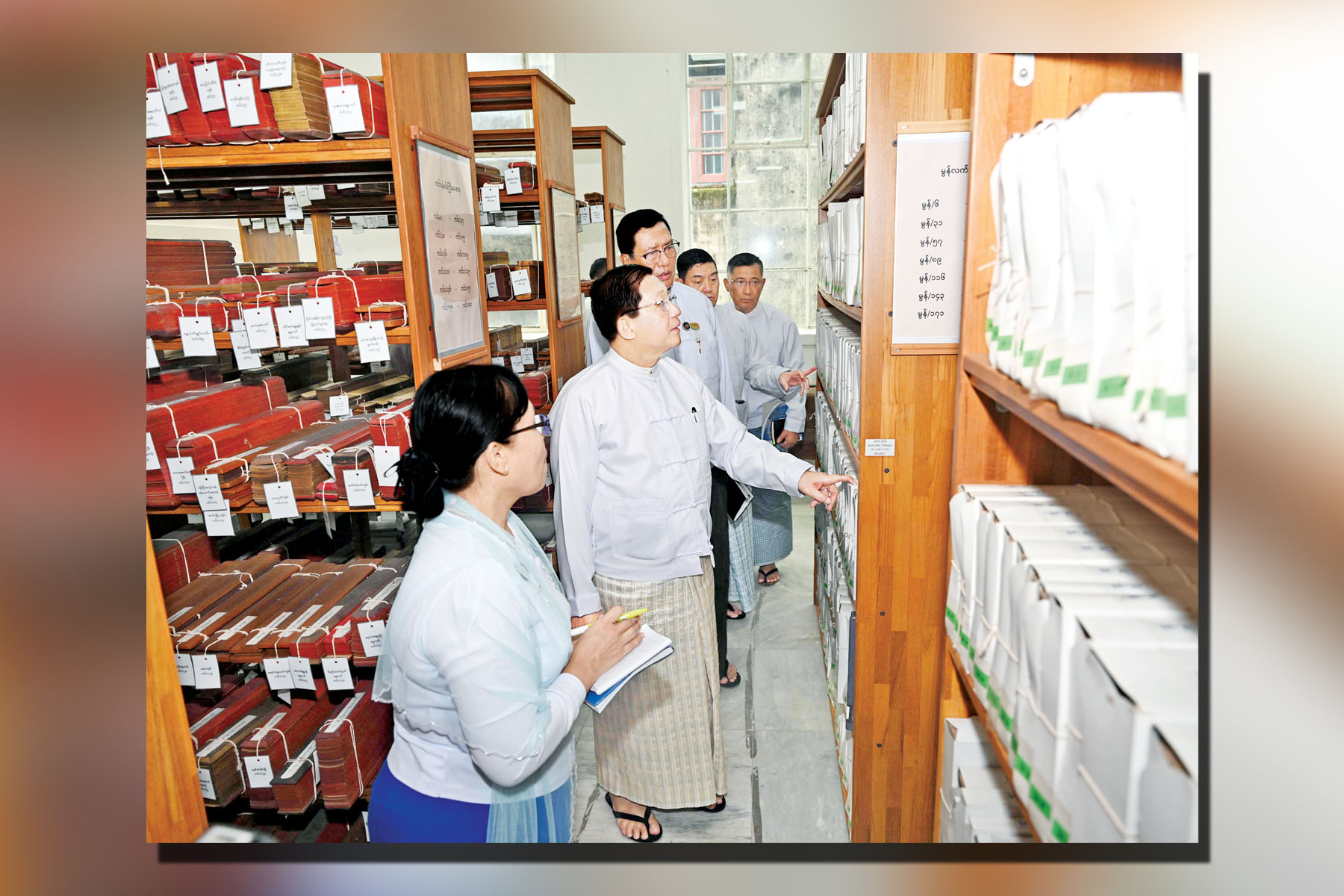
PRESIDENT of the Republic of the Union of Myanmar U Min Aung Hlaing yesterday afternoon visited the National Library (Yangon) and the National Museum (Yangon).
The President visited the National Library (Yangon) in Pabedan Township. The in-charge of the library reported to the President on the work process of the library, implementation of the digital library, library service and dissemination of library science, functions of the children’s library, arrangements for students to visit the library, conducting the library management diploma course, raising public awareness about copyrights, and cooperation with international libraries and organizations.
In providing guidance, the President said that the National Library (Yangon) is one of the nation’s historic libraries. It is necessary to preserve and maintain valuable historical books and publications comprehensively. Historical records serve as the cultural values and true reflections of the nation. It should be a library that houses books, literature, and records that contribute to the study of history, and it should become a meaningful and valuable library.
The President inspected the digital library on the first floor of the National Library (Yangon), the reference reading room, general reading room, and rare literary reading room on the second floor, the children’s library on the third floor, the data centre, bookshelf and small museum on the ground floor, where he viewed the books and publications. The President presented cash awards to librarians.
At the National Museum (Yangon) on Pyay Road in Dagon Township, Director-General U Kyaw Oo Lwin of the Department of Archaeology and National Museum reported to the President on the display of artefacts, visits of people and students, staging the internal and international shows, Efforts to submit Myanmar’s Thanaka and tea cultural tradition for inscription on the UNESCO list, visits of the State level dignitaries, efforts to emerge the digital museum, conducting the post-graduate museum diploma courses, and cooperation with international museums.
Speaking on the occasion, the President said that the National Museum serves as a place that represents the history and cultural values of the nation. Visitors will be able to see the strong and rich historical heritage of the country. Those who come to observe the museum will gain knowledge and understanding of the nation’s history and cultural values, fostering a sense of appreciation and a desire to preserve them.
It is necessary to firmly present historical records from different eras. By continuously viewing history from one period to another, people will come to understand and appreciate their national identity, pride in their heritage, and the great traditional values of their race, religion, and culture.
The President visited the booths of the museum where royal regalia and insignia, as well as ancient objects with evidence from the pre-historic era, the Stone Age, the Bronze Age and the Iron Age are put on display.
The President, in his guidance, stated that by observing the historical exhibits at the National Museum in this way, people will be able to learn about the high national pride and prestige of Myanmar, its sophisticated and rich cultural heritage, and the achievements of Myanmar’s ethnic peoples.
He underlined that as these are invaluable historical records that cannot be measured in terms of value, it is necessary to carefully preserve and manage them to prevent any damage or deterioration. At the same time, visitors should be allowed to study and observe these exhibits in an orderly and disciplined manner through proper supervision and preservation measures.
After signing the visitors’ book, the President presented cash awards for staff to an official. — MNA/ TTA