
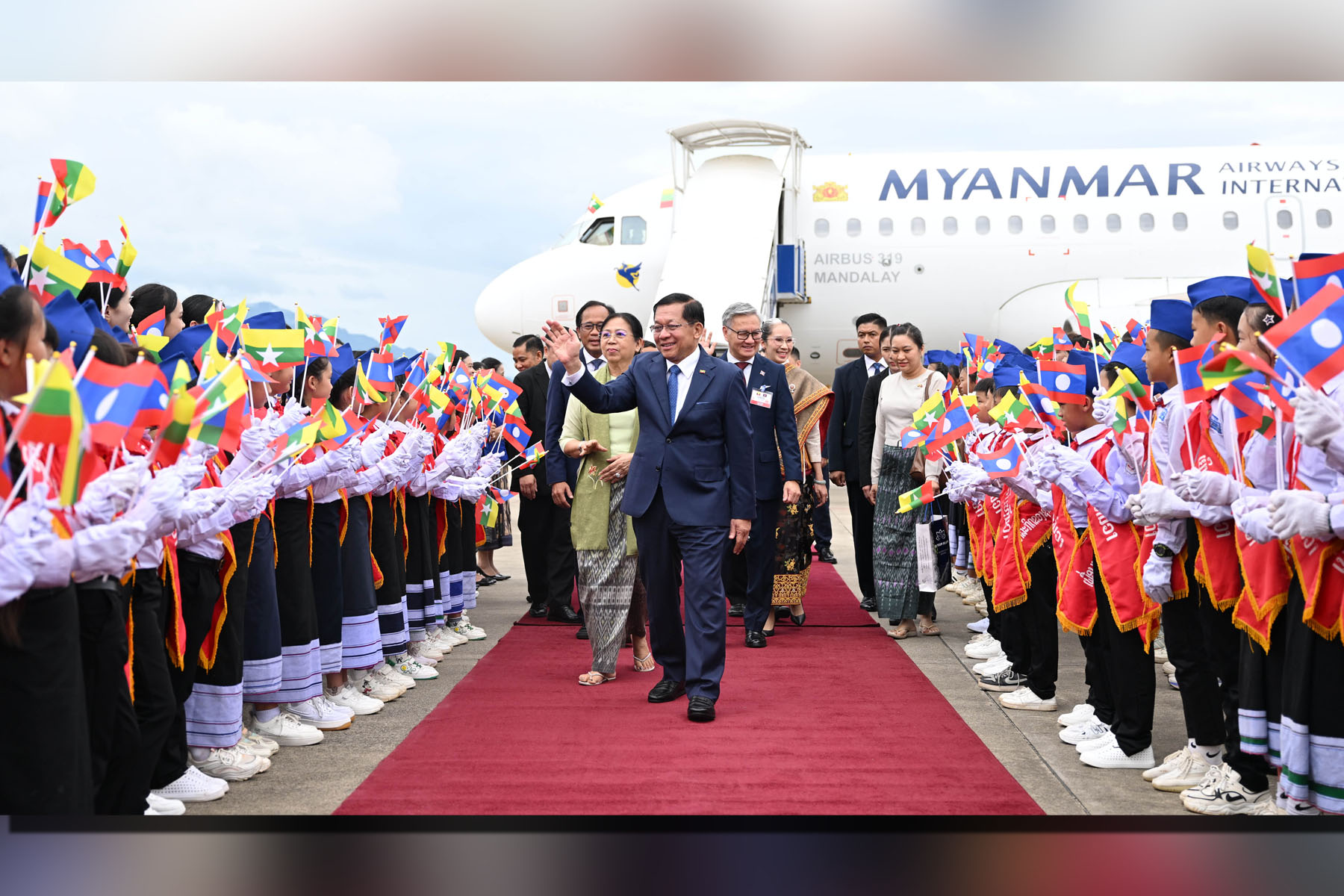
President of the Republic of the Union of Myanmar U Min Aung Hlaing and his spouse Daw Kyu Kyu Hla and delegation members visited the Royal Palace Museum in Luang Prabang yesterday morning.
The President, his spouse and delegation members left Wattay International Airport in Vientiane for Luang Prabang. They were warmly seen off at the airport by Minister at the President’s Office of Laos Mrs Phongsamouth Anlavan, senior officers from the Lao Government, and officials, along with the Guard of Honour.
On arrival at Luang Prabang International Airport, the President-led high-level Myanmar delegation was welcomed by Secretary of the Luang Prabang Provincial Party Committee Mr Bounleuam Manivong, his wife and officials. So also, the President and party were welcomed by scout youth along both sides of the red carpet by waving flags of both countries.
At the Royal Palace Museum, they were welcomed by officials. The President, his spouse and party paid homage to Laos’ Buddha Image Phra Bang in the museum and offered oil light and flowers. They donated the golden lotus robes, a scale model of Maravijaya Buddha Image for public obeisance and the record book on the construction of the image to an official. They also visited the chamber of the Buddha Image.
The Phra Bang Buddha Image is located to the right of the entrance to the Royal Palace Museum. It was cast in Sri Lanka in the 1st century and was presented by the Khmer king to his son-in-law, the Lao King Fa Ngum, as a gift in 1359. The temple housing the Buddha image was first constructed in 1963. However, construction was interrupted by the civil war and resumed in 1990 before the temple was officially inaugurated in 2006.
The President, his spouse and party viewed around the royal regalia used by ancient Lao kings displayed at the Royal Palace Museum.
The Royal Palace Museum is situated on the bank of the Mekong River and has been preserved as one of the country’s most revered sites. Originally, the palace was constructed entirely of teak. During its reconstruction, however, teak was replaced with brick, incorporating a blend of French Beaux-Arts design and traditional Lao architectural styles. Following the Lao takeover in 1975, the monarchy was abolished, and the royal family was required to leave the palace. It was subsequently converted into the National Museum. In 1995, UNESCO officially designated the entire city of Luang Prabang as a World Heritage Site. As part of that designation, the Royal Palace Museum was recognized as a key component of the city’s historic heritage core zone. The museum received this distinction for its outstanding fusion of French colonial architecture and traditional Lao artistic craftsmanship.
In the afternoon, the President, his spouse and party paid homage to Wat Xieng Thong Temple.
They also paid homage to the Buddha Image in the temple and offered oil light, flowers and golden lotus robes and donated a scale model of Maravijaya Buddha Image for public obeisance and the record book on construction of the image.
Wat Xieng Thong Temple was built during the reign of King Saya Setthathirath in the 16th century and was completed in 1560. It is regarded as one of the most remarkable examples of traditional Lao craftsmanship and architecture. The temple is particularly renowned for its gilded mosaic mural depicting the Tree of Life and the distinctive roof design of its ordination hall. It is widely believed that those who visit and pay homage at Wat Xieng Thong while in Luang Prabang Province will be blessed with good health, happiness, prosperity, and success. With its intricately gilded façade and colourful gold-and-glass mosaic decorations, the temple is considered one of the most beautiful Buddhist temples in Asia and attracts large numbers of tourists from around the world. — MNA/TTA