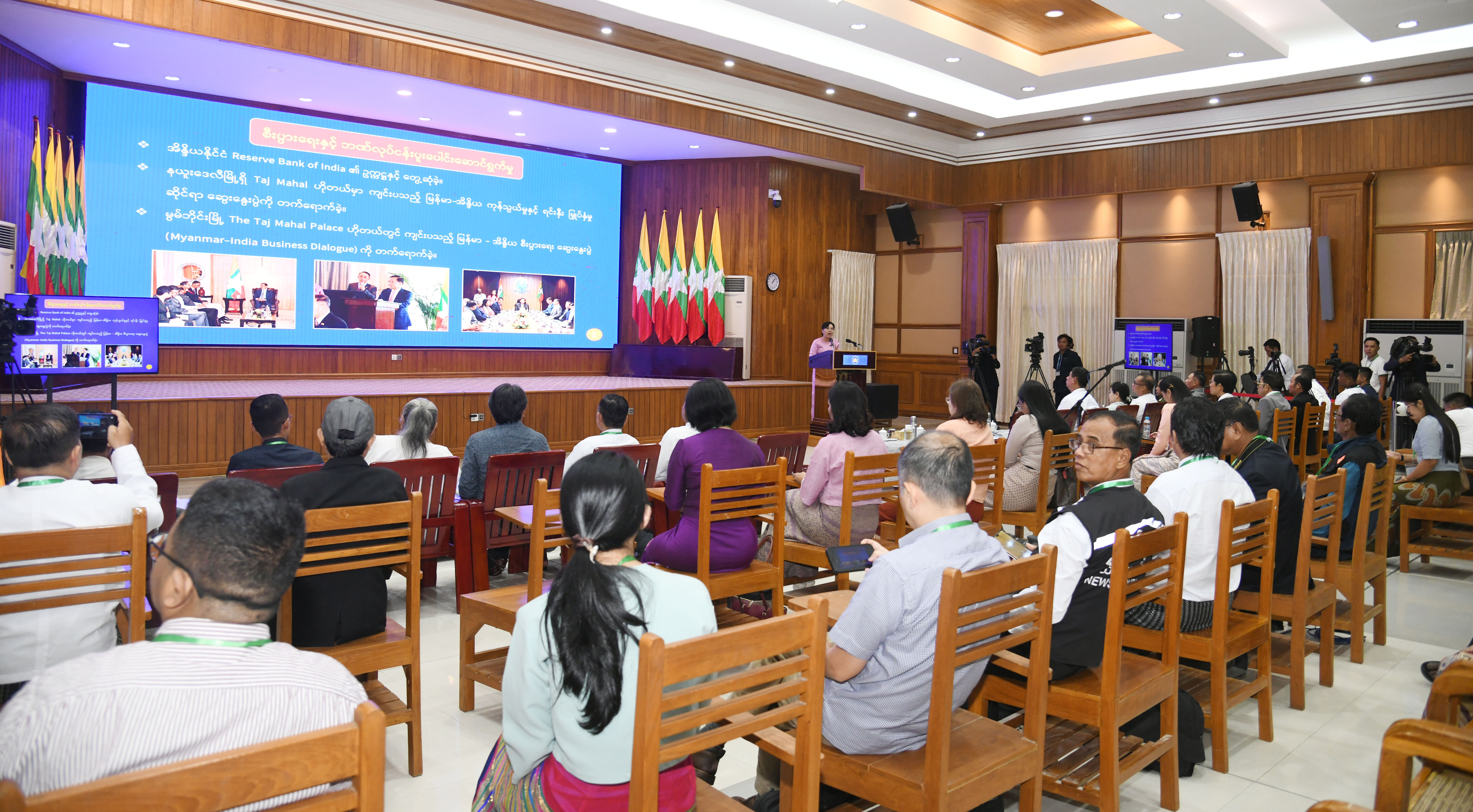
THE President’s Office held a press conference yesterday afternoon at its Multipurpose Hall in Nay Pyi Taw. Speaking at the event, Deputy Minister and President’s Office spokesperson Dr Khaing Khaing Soe briefed the media on the outcomes of the President’s recent visits to India and China, as well as the government’s progress under its 100-day action plan.
The spokesperson said the President’s visit to India was his first official overseas trip, which was made at the invitation of Indian Prime Minister Mr Narendra Modi. During the visit, the President met the President of India, the Prime Minister, and India’s National Security Adviser. Their discussions covered cooperation in education, healthcare, information and communications technology, border stability, counter-narcotics efforts, and measures to combat online fraud and illegal gambling.
She added that the two countries issued a joint statement agreeing to complete the Kaladan Multi-Modal Transit Transport Project, accelerate implementation of the India-Myanmar-Thailand Trilateral Highway, increase the number of Mekong-Ganga ICCR scholarships for Myanmar students from 36 to 100 starting in 2026, and further facilitate bilateral trade, including expanding the rupee-kyat payment system introduced in May 2024.
During the visit, the President also attended business and banking cooperation forums, Myanmar-India trade and investment meetings, and bilateral business dialogues. He visited an energy company and India’s Jawaharlal Nehru Port to study industrial development. According to the spokesperson, the visit resulted in diplomatic recognition from a major neighbouring democracy, agreements to strengthen trade, investment and economic cooperation, commitments to expedite the Kaladan project and the Trilateral Highway, and understandings on border security and mutual respect for each country’s sovereignty.
The spokesperson also said the President paid a state goodwill visit to China from 15 to 19 June at the invitation of Chinese President Mr Xi Jinping. During his trip, he held talks with President Xi Jinping, Premier Li Qiang, and Zhao Leji, Chairman of the Standing Committee of the National People’s Congress. Discussions focused on expanding comprehensive bilateral cooperation, supporting Myanmar’s development, working towards lasting peace in Myanmar, increasing Chinese investment, and promoting bilateral trade.
The President also discussed strengthening the Myanmar-China Comprehensive Strategic Cooperative Partnership, enhancing security and the rule of law, expanding economic and investment cooperation, maintaining stability along the shared border, accelerating Belt and Road Initiative (BRI) and China-Myanmar Economic Corridor (CMEC) projects, reaffirming Myanmar’s support for the One China Policy, and receiving China’s firm support for Myanmar’s new government.
During the visit, both sides signed memoranda of understanding covering human resource development, agriculture, trade, media, humanitarian assistance, space and artificial intelligence technologies, technology and knowledge exchange, and cooperation under the Global Security Initiative (GSI), Global Development Initiative (GDI), Global Civilization Initiative (GCI), and Global Governance Initiative (GGI). The President also toured several industrial and technology facilities, including the China Aerospace Science and Technology Corporation, the Shanghai Lingang Special Area, and Unitree Robotics. Additionally, his itinerary featured visits to railway construction projects, electric vehicle manufacturing plants, and bamboo-based textile and consumer goods factories.
He also inaugurated the Myanmar-China Investment and Trade Networking Forum, where business representatives from both countries signed more than 70 memoranda of understanding. A joint statement was also issued to accelerate the building of the China-Myanmar community with a shared future. The visit produced agreements covering diplomacy, friendship, economic cooperation, border stability and security, as well as collaboration in mining, the digital economy, artificial intelligence, renewable energy, railway construction, and mineral exploration.
The spokesperson said the President’s visits to India and China had delivered positive outcomes and created valuable opportunities for both countries and the new government.
She also outlined progress made under the government’s 100-day action plan, including achievements and ongoing work by various ministries. She highlighted school enrolment figures, the reopening of basic education schools, universities, degree colleges and science institutes, student attendance, the 2026 matriculation examination pass rate, the launch of new DEMU railway services by Myanma Railways during the first 100 days, and introduced the President’s Office Information and Public Relations Bureau’s official website and social media platforms.
The press conference concluded with a question-and-answer session, during which representatives from domestic and international media asked about plans following the discovery of natural gas reserves in Taninthayi Region, education cooperation and strategic relations with China following the President’s visit, the Myitsone Hydropower Project, Myanmar’s international diplomatic engagement, domestic peace efforts, poverty reduction initiatives under the 100-day plan, issues concerning individuals on blacklists and their family members, and the country’s cooperation with international partners on infrastructure development projects. She responded to the questions and provided further clarification. — MNA/ST