
Administrative bodies face an immediate mandate to crack down on unauthorized developments and restore public order under prevailing rules and regulations.
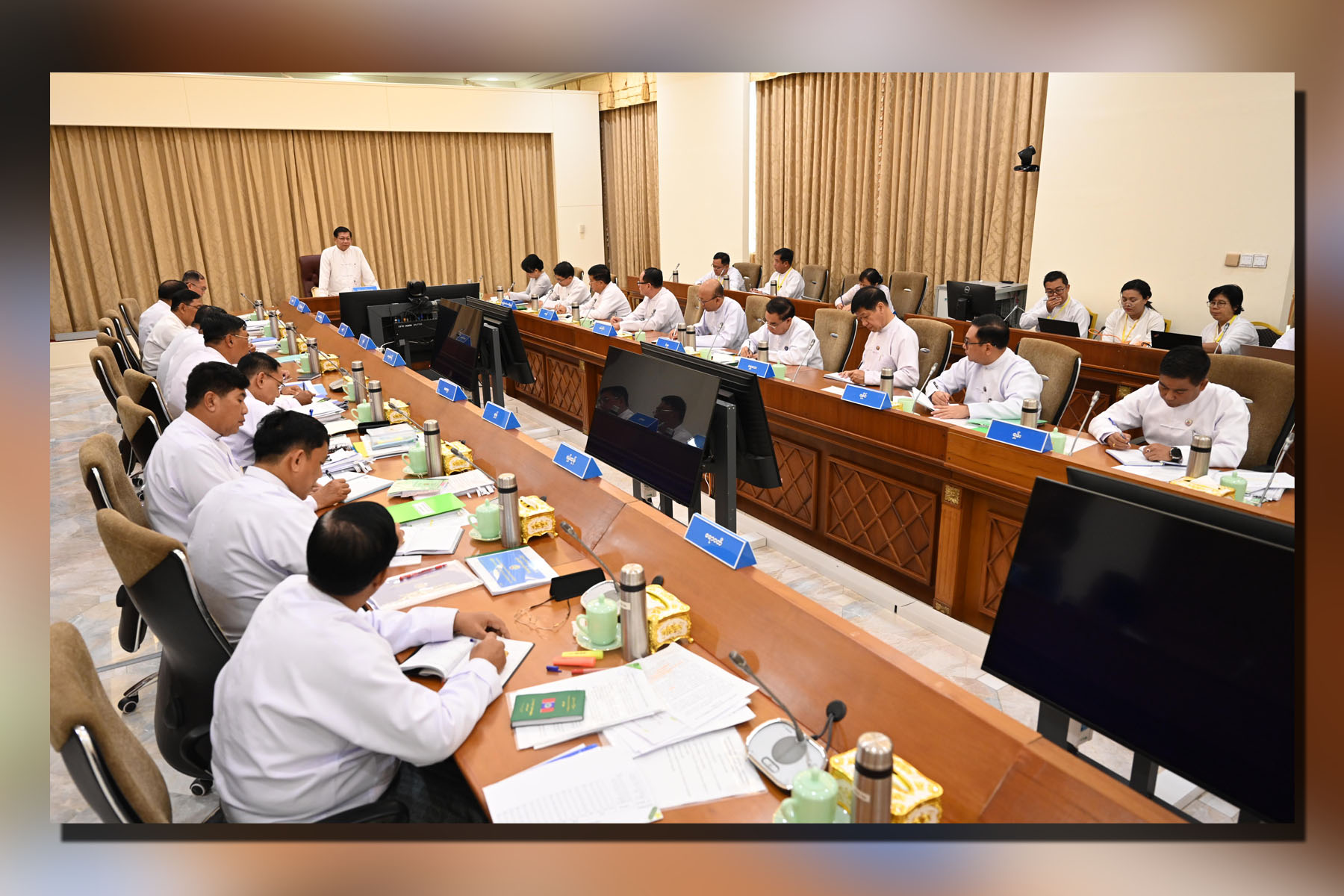
IT is necessary to prioritize the improvement of transport and communication links in remote border areas, said President of the Republic of the Union of Myanmar U Min Aung Hlaing at the meeting with the Nay Pyi Taw Council chairman, chief ministers of regions and states at the President’s Office yesterday morning.
In his speech, the President stated that the required funds for transport and communication projects are being provided by the State.
In the construction sector, he noted that residential houses are being built and inhabited along roadside areas and in locations that are neither classified as village land nor urban land. Such settlements may lead to administrative difficulties. Therefore, relevant administrative bodies are required to strictly supervise and manage these developments in accordance with rules and regulations to ensure proper order.
In the development measures, he stressed the need to make use of the respective strengths of each region and state in carrying out development activities. In doing so, since micro, small and medium enterprises (MSMEs) play a key role, efforts should be made to promote MSMEs to develop domestic production activities further.
Regarding the economy, the President pointed out that if domestic production increases, imports can be reduced and exports can be expanded. By doing so, it would be possible to moderately ease rising commodity prices. It is also noted that higher prices of input materials have led to increased production costs, which in turn have contributed to rising commodity prices.
With regard to generating employment, he underlined that residents prefer to live and work within their own areas, and if job opportunities are abundant, they will choose to stay and work locally. Therefore, it is necessary to promote and create employment opportunities in each respective region.
Regarding increasing agricultural production, he instructed that it is necessary to improve crop cultivation capacity and enhance multiple cropping systems. Likewise, efforts should be made to develop the livestock sector further. In relation to agricultural and livestock sciences, it is also necessary to provide scholarships where needed and train skilled personnel accordingly. If agricultural activities are carried out through a collective system, the work can be completed more quickly and successfully.
In the education sector, the President underscored that there is a need for primary school teachers, and it is essential that teachers are capable of teaching students in a systematic manner. Therefore, the teachers to be appointed should be continuously provided with ongoing training in teaching methodologies and educational skills.
Aiming at improving the health sector, he outlined that the government will take steps to ensure that doctors and nurses are continuously available in hospitals by increasing staffing levels. It will also increase state funding to improve the health sector.
For the improvement of the physical and mental well-being of the public, the President emphasized that it is necessary to organize sports competitions at the regional level. To enable such activities, existing sports grounds must be properly maintained and systematically developed.
Union Ministers U Khin Maung Yi, Dr Chaw Chaw Sein, Dr Myo Thein Kyaw, U Min Naung and U Myo Thant, the Nay Pyi Taw Council Chairman, region and state chief ministers reported on the release of the matriculation results, raising the pass rate, increase of enrolment in 2026-27 academic year, appointment of teachers at basic education schools, structuring schools meeting set standards, correct sown acreage and scrutiny for boosting per-acre yield of crops in regions and states, production of quality strains, use of farmlands under the law, construction and repair of roads, bridges and buildings in regions and states on priority, and development of relevant regions. — MNA/TTA