The domestic capability to construct large frigates has significantly strengthened the Tatmadaw’s capacity to uphold its national defence and security responsibilities.
A ceremony to launch the 40,000-tonne dry dock for the Naval Dockyard Command of Tatmadaw (Navy) was held in conjunction with the placing of keel for two submarine destroyers and commissioning war vessels yesterday morning.
These ceremony took place at the dockyard workshop and the naval jetty, attended by State Security and Peace Commission Chairman and Commander-in-Chief of Defence Services Senior General Min Aung Hlaing.
Officials cut the ribbon to open the 40,000-tonne dry dock of the Naval Dockyard Command. The Senior General unveiled the stone post of the dockyard and sprinkled scented water on the stone post and the plaque of the dockyard building. He also inspected the functions of the shipyard management software room.
On the occasion, the Senior General delivered a speech. He said: The 40,000-tonne dry dock will also accommodate the keel-laying ceremony for the construction of the first two warships. Alongside this, Tatmadaw (Navy) will commission a large frigate, King Thalun, and four multipurpose riverine combat vessels. This achievement is a source of pride for both the nation and Tatmadaw.
Since 2018, plans have been implemented to construct a large dry dock capable not only of building and repairing the war vessels needed for the future Tatmadaw (Navy) but also of constructing and repairing large civilian cargo ships, thereby supporting the economic interests of the nation in multiple ways.
In the shipbuilding sector, the ability to domestically construct large frigates has greatly supported Tatmadaw in fulfilling its national defence and security responsibilities, while also strengthening the control and security of Myanmar’s territorial waters.
The two warships to be placed their keels today at the launching ceremony are the first war vessels at the 40,000-tonne dry dock. The ability to build these ships will enhance Myanmar’s maritime defence capabilities. Tatmadaw (Navy) began its shipbuilding activities in 1960, giving it considerable construction experience; however, it must continue to diligently study, learn, and apply modern shipbuilding techniques in line with current advancements.
Since the dry dock is an internationally advanced facility, personnel are encouraged to operate the dock and its equipment efficiently, fully utilizing their lifespan and capabilities. Efforts should be made to construct and repair large vessels for both domestic and international maritime trade to ensure returns on investment. Ship architecture and shipbuilding operations, as well as the development of human resources, must be steadily advanced. New-generation naval officers and servicemen assigned to various roles should be guided by sound traditions and practices. In fulfilling their duties to protect Myanmar’s maritime territory and interests, they are urged to uphold and preserve the Tatmadaw’s fine traditions with the same vitality and dedication.
The Senior General and attendees watched a video clip on construction of the dry dock.
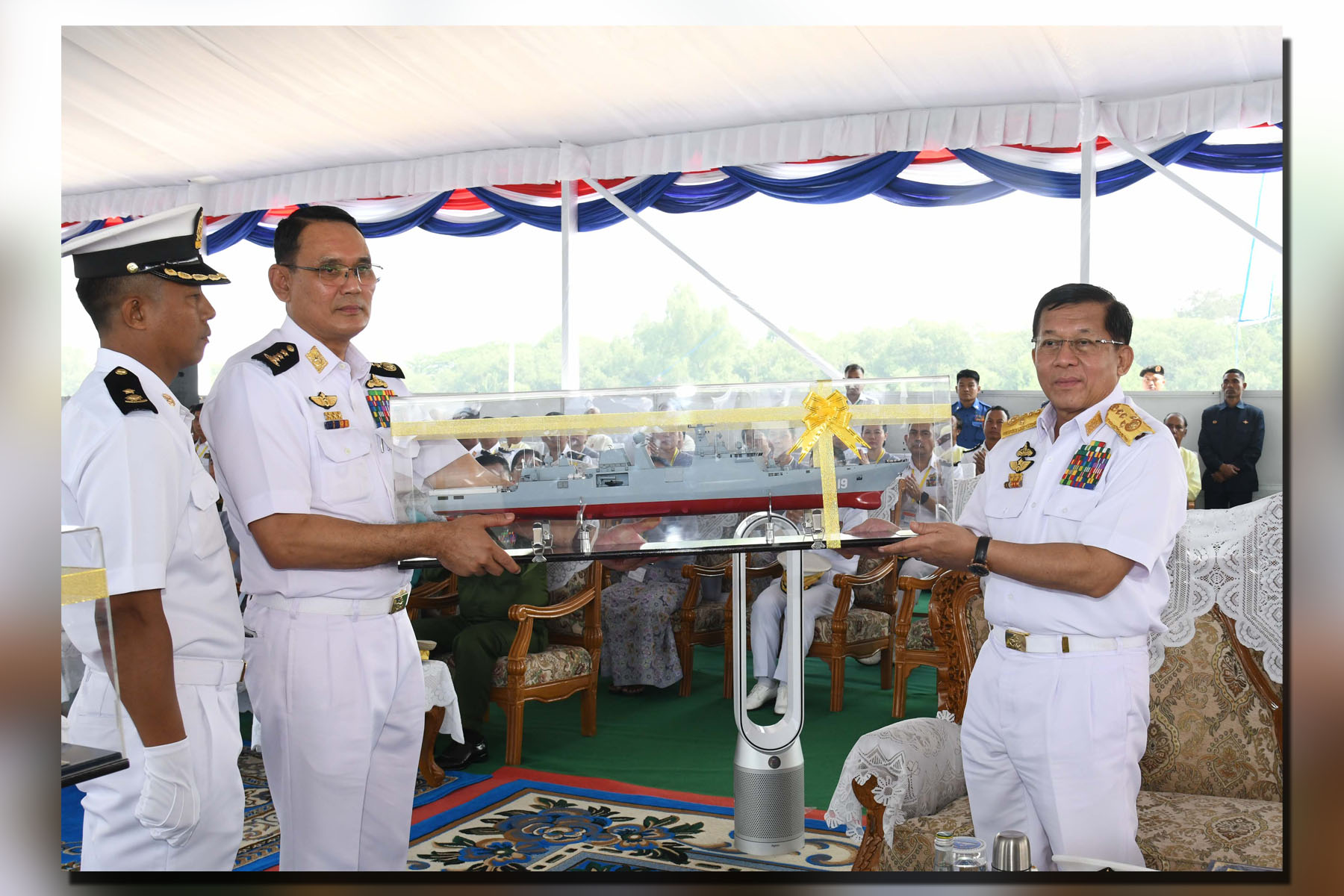
The chair of the company, taking responsibilities for construction of the dry dock of the Naval Dockyard Command Headquarters handed over documents related to the dry dock to the commander of the Naval Dockyard Command. The Commander-in-Chief (Navy) presented a gift in commemoration of the opening of the dry dock to the Senior General, who gave the fruit basket to the company chair.
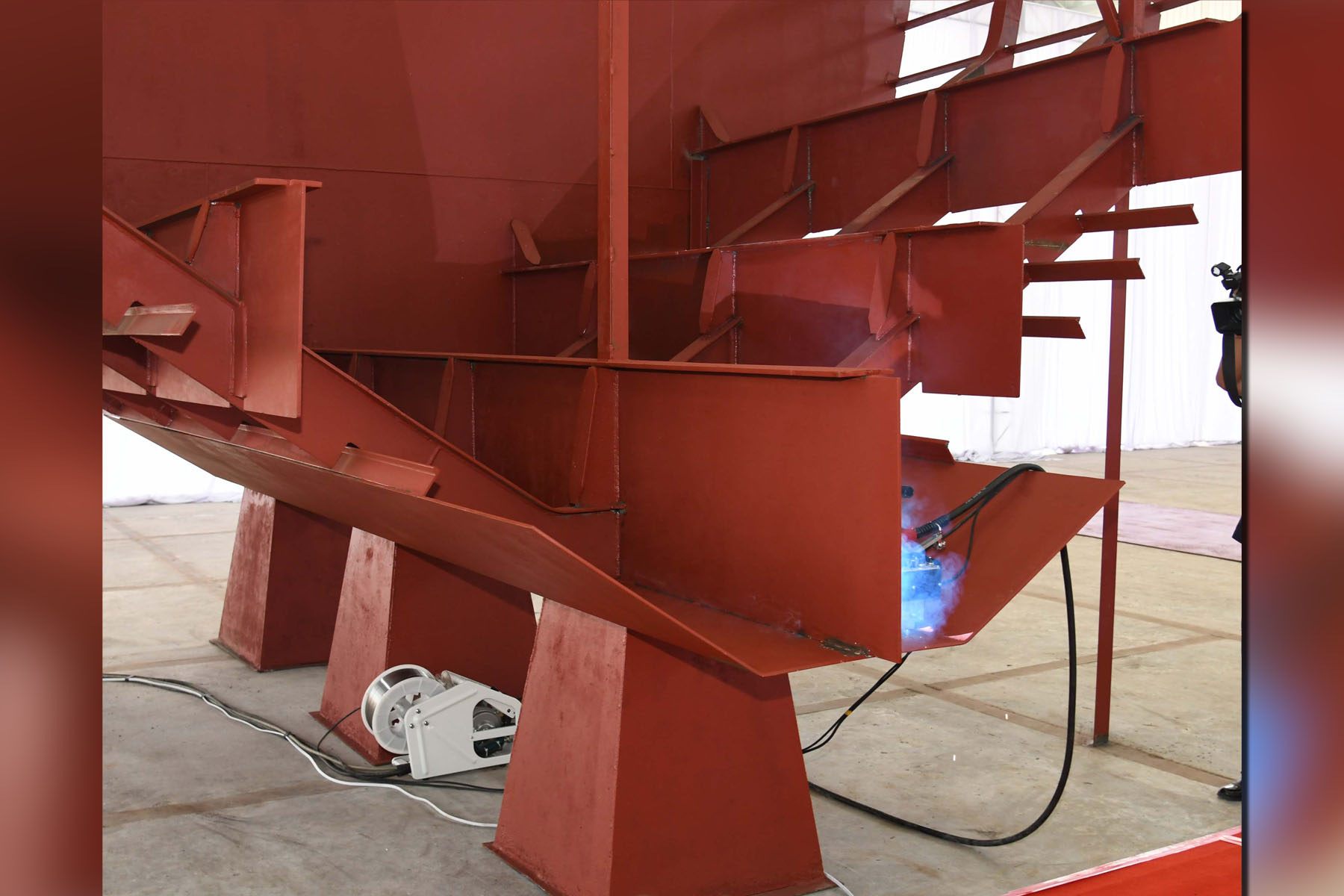
An official reported on the construction of war vessels at the ceremony to place the keel of two submarine destroyers.
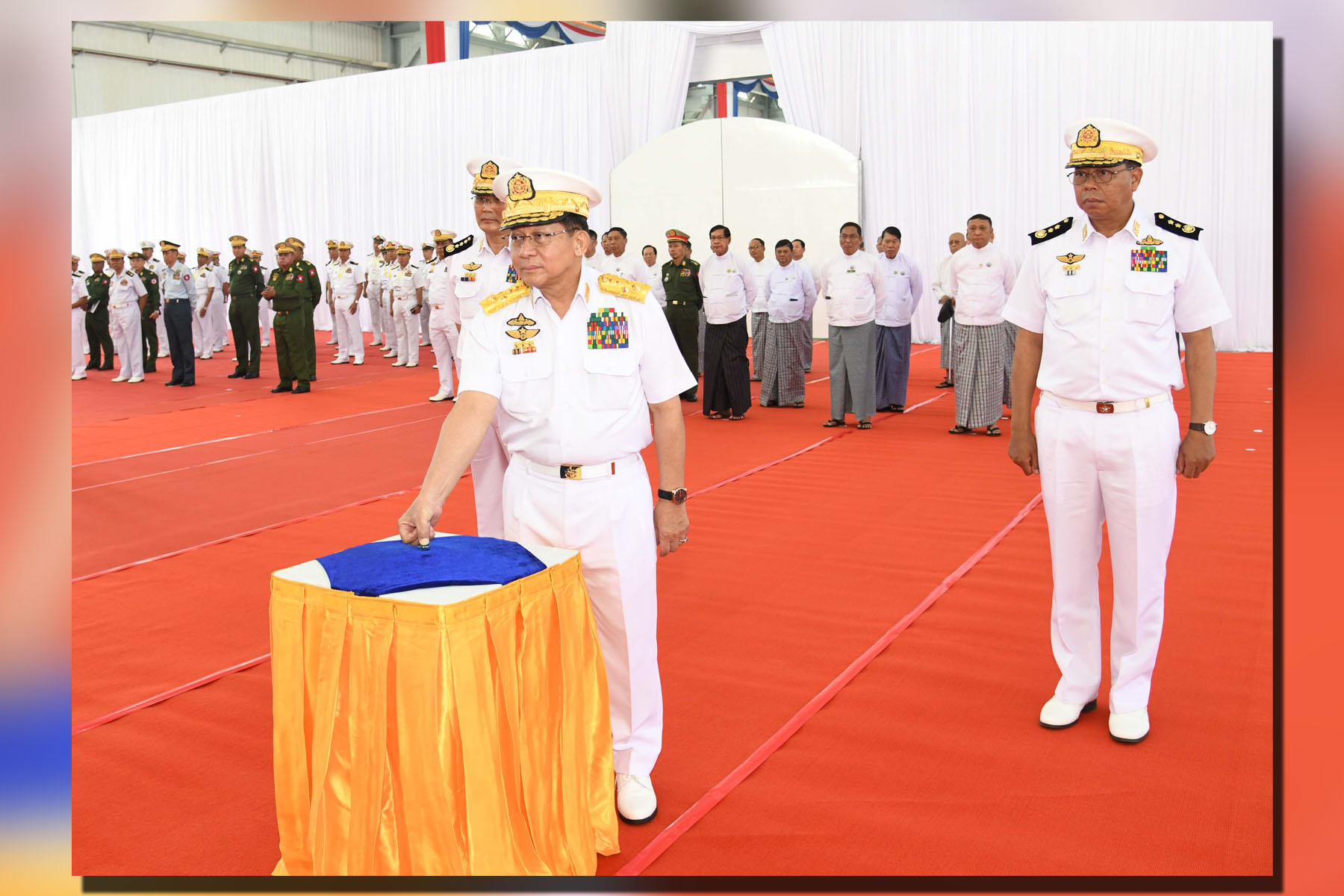
The Senior General pressed the button to weld the keel and frame of two submarine destroyers to launch the shipbuilding process and sprinkled scented water on the bronze plaque of keel and body parts.
The Senior General and party inspected the shipbuilding process and visited the gallery of shipbuilding and the dry dock, leaving necessary guidance.
The Naval Dockyard Command’s shipyard project was initiated in three phases. The first-phase project was successfully constructed and launched between 1998 and 2002, and the second-phase project from 2009 to 2013, enabling the construction and repair of war vessels as well as departmental and private ships. The third-phase project began construction in 2019, and today the third-phase facilities have been successfully inaugurated.
The Naval Dockyard Command’s 40,000-tonne dry dock can construct large war vessels, and is capable of simultaneously building or repairing either one 40,000-tonne commercial ship or two large warships. It can also construct and repair large warships, cargo ships, and container ships, thereby enhancing the country’s maritime economic benefits and naval capacity, and providing substantial support for national development.
The commissioning of war vessels of Tatmadaw (Navy) took place at the navy jetty in Yangon, attended by the Senior General.
Also present at the ceremony were his wife Daw Kyu Kyu Hla, Commission Secretary Commander-in-Chief (Army) General Ye Win Oo and his wife, Commander-in-Chief (Navy) Admiral Htein Win and his wife, Commander-in-Chief (Air) General Tun Aung and his wife, Union-level dignitaries and their wives, retired commanders-in-chief (Navy) and their wives, senior military officers from the Office of the Commander-in-Chief, the commander of Yangon Command, commanders of Naval Commands, commanders of Naval Bases, officers and other ranks from Tatmadaw (Navy) and guests.
Admiral Htein Win reported on the ceremony to commission naval vessels into service. The commander of Naval Dockyard Command handed over documents related to the war vessels to the commander of No 1 Flotilla.
The Senior General presented the banners and flags of the commissioning ceremony to the Commander-in-Chief (Navy), who handed them over to relevant commanding officers of vessels.
Chief of Staff (Navy) Vice-Admiral Aye Min Htwe declared the commissioning of war vessels and led the process of hoisting the State flag, the Tatmadaw (Navy)’s flag and commissioning flags and beat the bell nine times as the commissioning process.
The Senior General and party inspected Frigate King Thalun and four multipurpose riverine combat vessels.
The Senior General took the salute of the Guard of Honour. Meanwhile, warships Yan Taing Aung and Yan Gyi Aung fired a total of 21 rounds in salute to honour the Senior General.
The Senior General presented medals and certificates of honour to officers and other ranks who participated in building the war vessels.
At the commissioning ceremony, Frigate King Thalun is the largest vessel in the history of the Navy’s shipbuilding that has been domestically constructed and commissioned. Over a period of more than one month, it completed over 270 hours of sea trials, covering a distance of some 3,500 nautical miles. During these trials, standard performance tests were conducted, and the onboard equipment was evaluated to ensure it could be used according to prescribed standards. And, it was commissioned into service yesterday. With the successful commissioning of this domestically built warship, the Navy’s capacity to fulfil its national defence and security responsibilities has been significantly strengthened. — MNA/TTA