
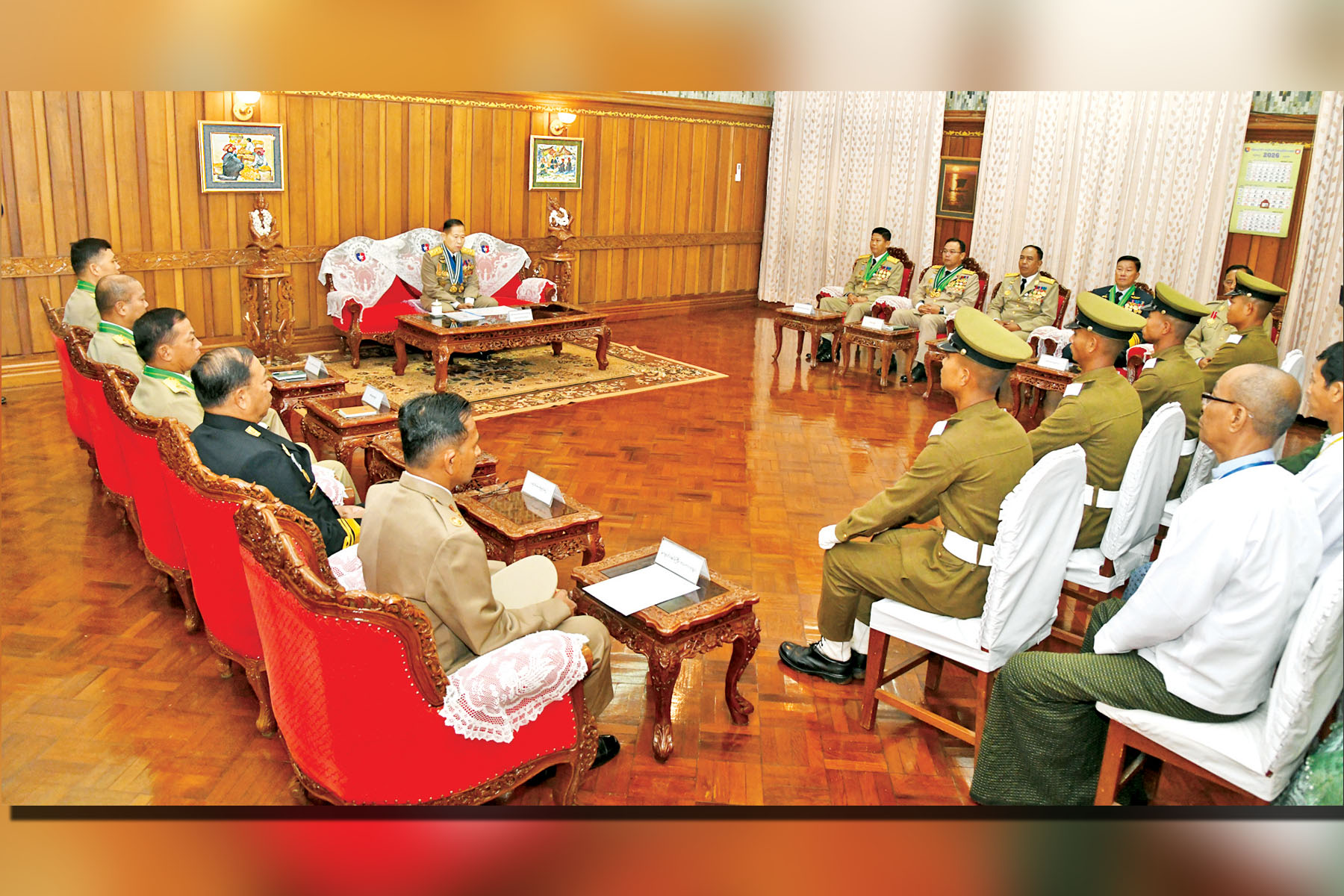
As Tatmadaw members are citizens who voluntarily joined Tatmadaw to defend the country, they must strictly follow not only the military laws and rules and regulations but also the existing laws, rules and regulations set by the government as a citizen, said State Security and Peace Commission Vice-Chairman, Defence Services Deputy Commander-in-Chief, and Commander-in-Chief (Army) Vice-Senior General Soe Win.
Vice-Senior General Thiri Pyan Chi Maha Thray Sithu Soe Win delivered a speech at the passing out parade of the 129th intake of Tatmadaw (Army) Officer Training School (Bahtoo) at its parade ground yesterday morning on behalf of State Security and Peace Commission Chairman Commander-in-Chief of Defence Services Senior General Thadoe Maha Thray Sithu Thadoe Thiri Thudhamma Min Aung Hlaing.
Cadet companies saluted the Vice-Senior General, who also inspected the cadet companies.
He presented a silver sword award to the best cadet award winner, Cadet Ye Htut Aung.
At the passing out parade, the Vice-Senior General delivered a speech. He said the junior leaders who are going to serve on the battle grounds and practical fields will be notified of certain matters that they should know. Tatmadaw was born together with the independence struggle, evolving successively from the BIA, to the BDA, the BNA, the PBF, and later the Burma Army, and it led the people in gaining independence and protected and safeguarded it.
After gaining independence, due to the colonial divide-and-rule system and instigation, internal armed conflicts based on ideological divisions and splits arose. Therefore, Tatmadaw, which is responsible for national defence, has safeguarded Our Three Main National Causes and worked together with the people to resolve internal armed conflicts.
He urged the newly appointed junior leaders to exercise correct leadership over their subordinates and to build the three essential capabilities. Leadership is not an automatic skill but one gained through personal study, practice, effort, and experience. To provide proper leadership, they must maintain fairness, correct attitudes, avoid discrimination among subordinates, and uphold high moral integrity, he added.
He then encouraged the junior leaders to apply the 16 characteristics of a leader set by Tatmadaw in administering their subordinates and to treat them like their parents, a good commander and role model.
He emphasized that the success or failure of any organization depends largely on how well officers and other ranks combine their military knowledge with combat power in a systematic manner, their effort, and their adherence to discipline. Tatmadaw has remained strong since its emergence due to the discipline and obedience of successive generations. Therefore, discipline must be strictly observed in all matters. The 60 Codes of Conduct for soldiers encourage what should be done, while the 41 offences under the Defence Services Act prohibit what should not be done. Failure to follow rules, regulations, directives and orders would gradually lead to defeat.
As Tatmadaw members are citizens who voluntarily joined Tatmadaw to defend the country, they must strictly follow not only the military laws and rules and regulations but also the existing laws, rules and regulations set by the government as citizens. Discipline is the foundation of the Tatmadaw, and all must stay in accordance with the discipline and also ensure their subordinates adhere to it.
He then highlighted the importance of physical and mental fitness to be able to perform duties anytime and anywhere, and the need to train the fellowships to improve their combat ability and to avoid alcohol, betel quid, cigarette and gambling.
He also urged the junior leaders to nurture reading for their mental strength, critical thinking and morale.
He added that training is the lifeblood of a fully qualified force, and urged the junior leaders to continue their learning in military-related subjects, be aware of military affairs and security and learn the advancing military technologies.
He continued that efforts are being made for Tatmadaw to be a Standard Army with full combat ability and combat power to defend the country in full power. Combat capability refers to the quality of an individual soldier, and combat power refers to the effective use of weapons and equipment. Both require continuous training with the use of modern weapons.
Moreover, Tatmadaw upheld Our Three Main National Causes as a national task, showing their patriotism and loyalty to the country and people while serving national defence duties, rescuing victims of disasters and conducting rehabilitation processes when the country faced serious crises such as invasions, revolution, pandemic and natural disasters and so on.
He added that when the country moves towards a modern developed multiparty democratic system, Our Three Main National Causes are set as a national policy, and Section 383 in Chapter 8 of the 2008 Constitution also states that “every citizen has the duty to uphold: (a) non-disintegration of the Union; (b) non-disintegration of national solidarity; and (c) perpetuation of sovereignty,” and so all must safeguard it without fail.
He continued that state stability is essential for the socioeconomic status of people. The extremist terrorist groups that do not want state stability and socioeconomic development currently explode the road and bridges, aiming to cause difficulties in public transportation and goods flows.
Due to the efforts of Tatmadaw, the terrorists retreated from their locations, and some PDF terrorists working with NUG, CRPH and ethnic armed groups now rejoin the legal framework, and the number of returnees has reached 1,341 from 2021 to date.
The rehabilitation activities, such as resuming governance mechanisms, departmental offices, repairing houses, reopening schools and hospitals in the townships, where stability was regained, are being conducted. The needed security measures are also being made for the local ethnic people.
Tatmadaw set two political objectives: to strengthen genuine and disciplined multiparty democracy and to establish a Union based on democracy and a federal system, and also set a roadmap and objectives to be able to walk firmly on a multiparty democratic pathway that is the entire desire.
He said the 2025 multiparty general election was successfully held in three phases starting from 28 December 2025, with 13.13 million out of 24 million eligible voters participating (54.22 per cent). He stated that state responsibilities would be transferred to the elected government by the State Security and Peace Commission in accordance with democratic standards.
He then mentioned the motto “Strength of the nation lies within,” and urged building a unity between the Tatmadaw and the people.
Regarding the attempts to defame Tatmadaw, the Vice-Senior General highlighted the need to enhance unity within and outside of the military units with the correct leadership upon the family members to have the right knowledge, belief and stances. He also highlighted the importance of unity within and outside of the military units.
After taking the salute of the cadet companies, the Vice-Senior General left the parade ground.
After the ceremony, the Vice-Senior General met the outstanding award-winning cadets together with senior Tatmadaw officers from the Office of Commander-in-Chief of Defence Services and the commander of the Eastern Command. — MNA/KTZH