
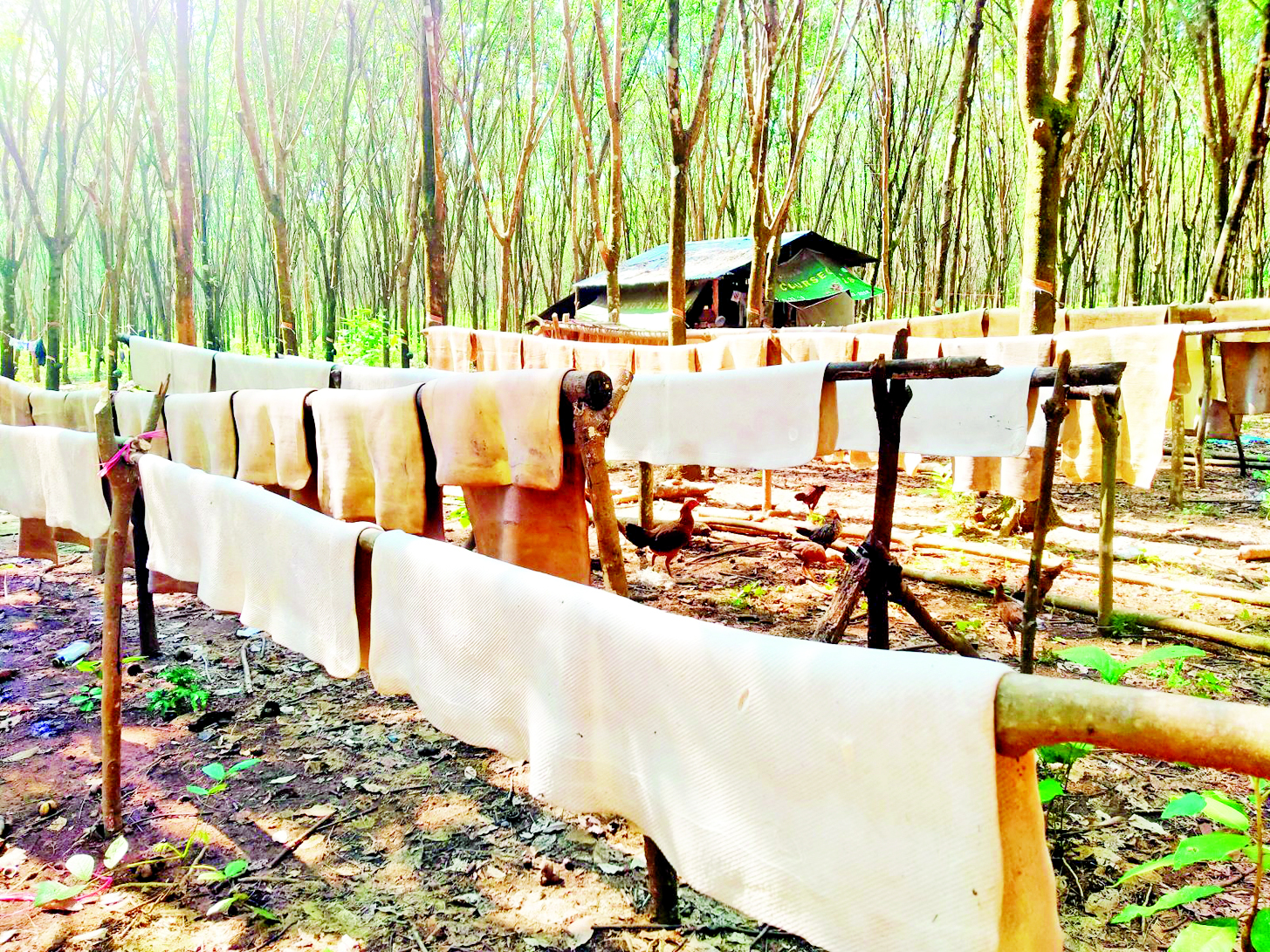
CONCERTED efforts are being exerted to expand and establish Group Processing Factories to enhance the quality of Myanmar’s rubber in the global market.
Rubber is one of the key sources of foreign revenue for Myanmar. The GPF are designed to consolidate raw latex into high-value, standardized rubber, enabling small-scale farmers to manufacture premium-grade rubber by pooling resources.
Adopt ing modern drying techniques, farm-to-factory traceability, and compliance with international standards will help Myanmar rubber to reach the European market, which demands premium rubber at high prices.
At present, China accounts for 75 per cent of Myanmar’s rubber exports, followed by Malaysia, Indonesia, India, Viet Nam and the Republic of Korea.
Myanmar possesses over 1.6 million acres of rubber plantations, producing over 300,000 tonnes and generating US$480 million in revenue. Nonetheless, the lack of quality rubber pushed Myanmar to export only raw materials, lowering the global market price.
The GPF system was implemented in early 2026 to organize small farmers to produce premium-quality rubber, as 92 per cent of rubber farmers are smallholders. The Group Processing factories producing RSS3 rubber are being operated in Shwegyin and Mayanchaung in Bago Region, Kyaikto, Thaton, Mudon and Thanbyuzayat in Mon State and Myaingkalay in Kayin State, and expansion of facilities is also ongoing. — TWA/KK