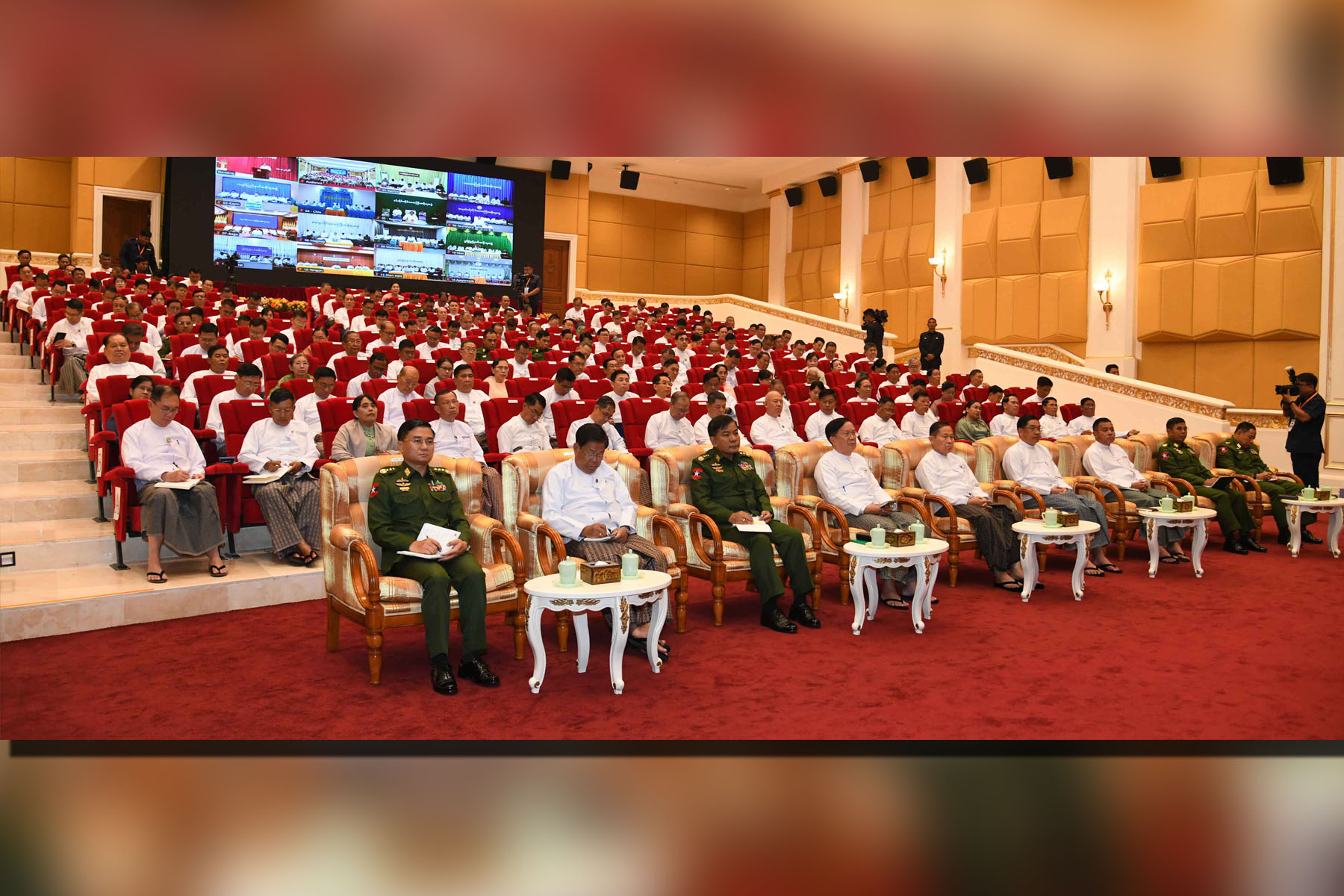
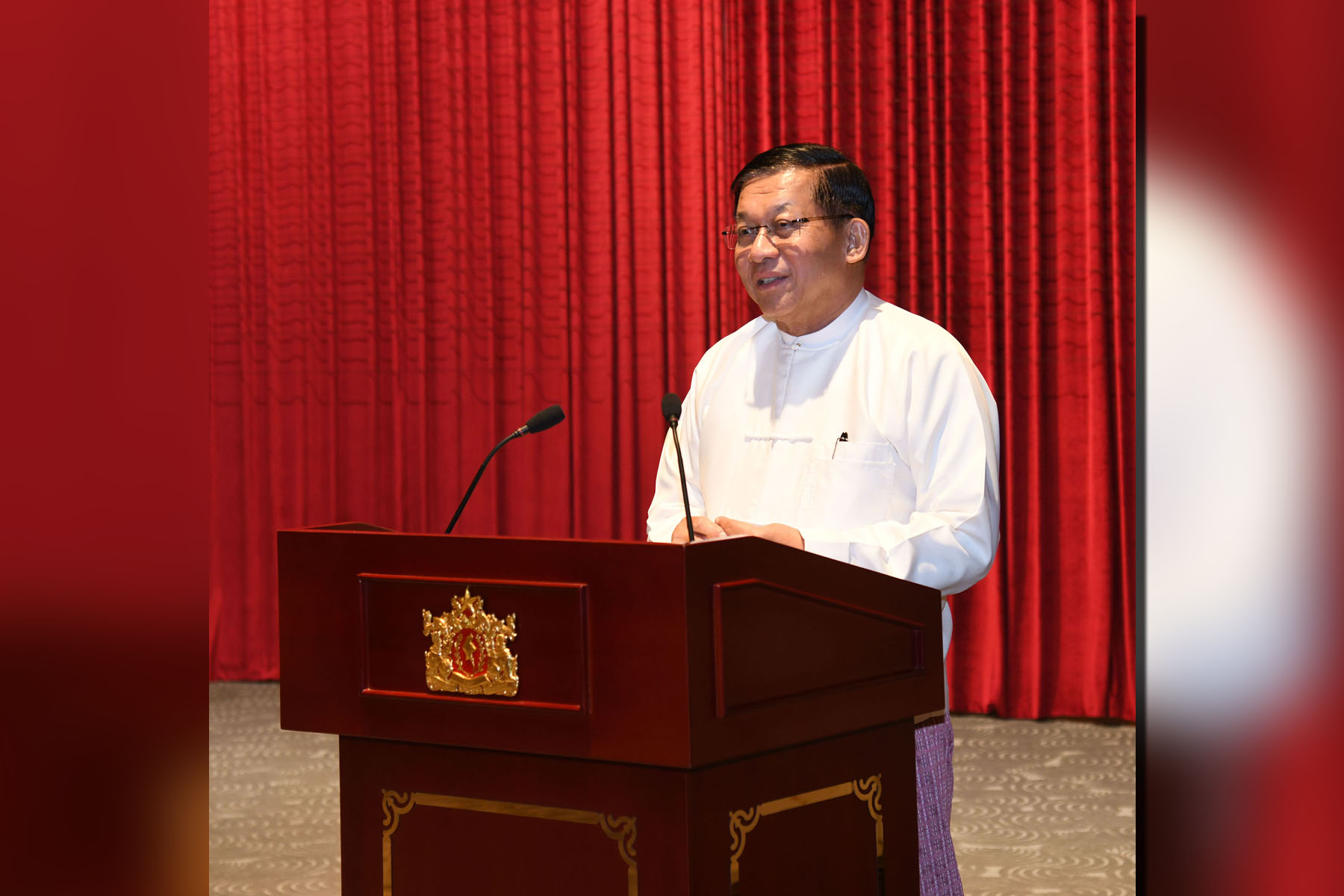
Acting President of the Republic of the Union of Myanmar and State Security and Peace Commission Chairman Senior General Min Aung Hlaing delivered a speech on review of development undertakings of the government from 2021 to 2025 at Thabin Hall of the Office of the National Defence and Security Council in Nay Pyi Taw yesterday afternoon.
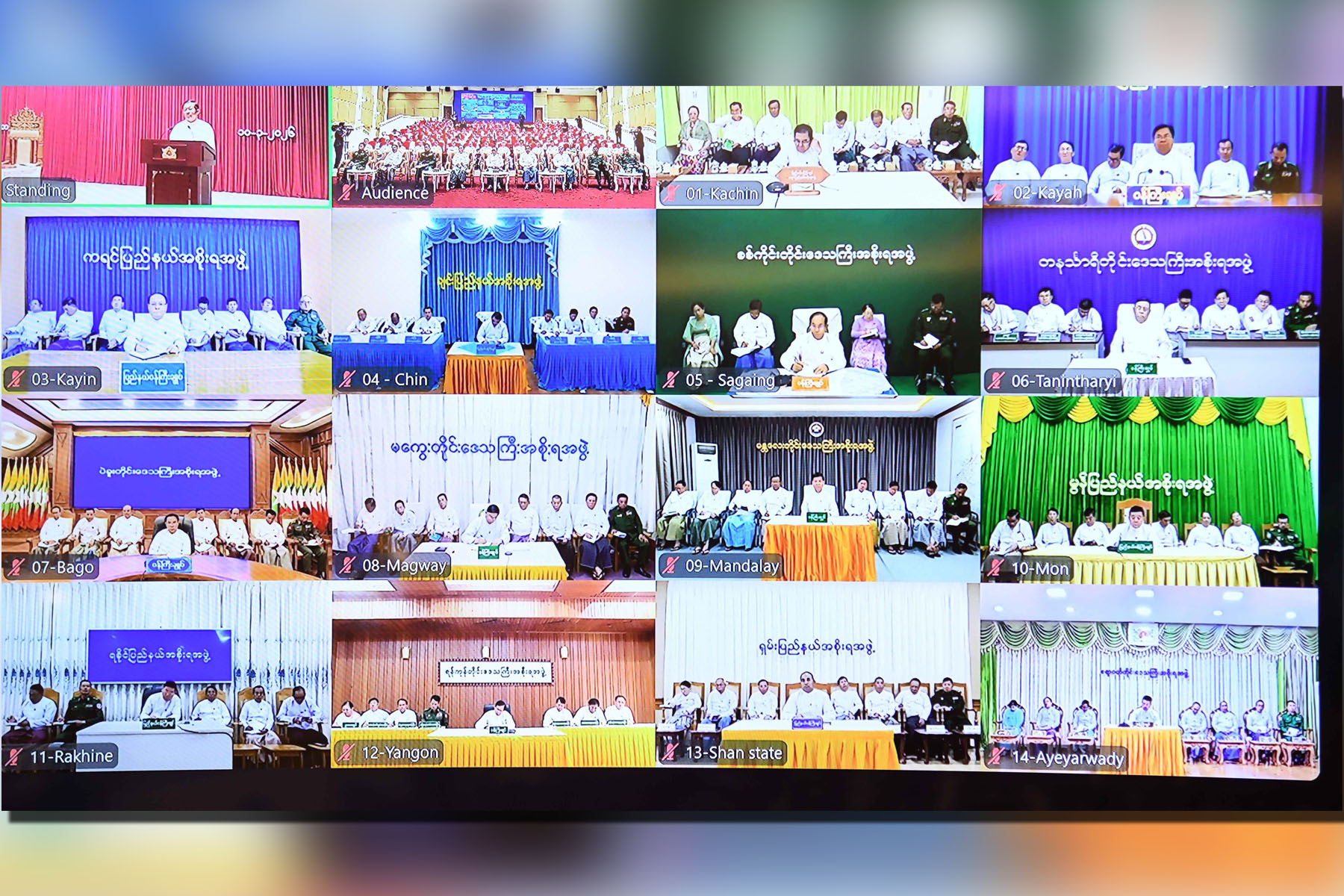
Also, present at the ceremony were Commission Vice-Chairman Vice-Senior General Soe Win, Commission member Prime Minister U Nyo Saw, Executive Chief U Aung Lin Dwe, Commission Secretary General Ye Win Oo and commission members, Union-level dignitaries, Union ministers, deputy ministers, permanent secretaries and directors-general of ministries, together with chief ministers and members of region and state governments through videoconferencing.
Speaking on the occasion, the Senior General delivered a speech. He said: As we assumed responsibility for the State in accordance with the Constitution, the government was not formed solely with members of the Tatmadaw to ensure compatibility with the democratic system. Instead, it was constituted by also including experienced civilians capable of serving the national interest. At the time we began undertaking State responsibilities, we adopted and implemented five forward-looking processes. Among them, it was clearly stated that once the election-related processes were completed, a general election would be held, and State responsibilities would be transferred to the government that emerges from that election. However, during the period in which we assumed these responsibilities, political disagreements led to nationwide protests that escalated into acts of violence. At the same time, the COVID-19 pandemic was also occurring. Therefore, amid various difficulties and challenges, efforts had to be made to maintain national stability and peace while promoting development.
Preparatory measures were undertaken in advance in order to hold a free and fair multiparty democratic general election. To ensure the accuracy of voter lists, the 2024 Population and Housing Census was conducted. Similarly, preparations were also made to enable the casting of votes using the Myanmar Electronic Voting Machine (MEVM) system. In 2024, during a visit to Meiktila, it was first announced, while meeting with local people, that the election would be held in 2025. Registration of political parties was permitted starting in 2023, and political parties were given approximately three years to make preparations.
In addition, in order to expand party membership, membership recruitment activities were allowed in accordance with rules and regulations. In the election, six parties contested as nationwide parties, while 51 parties participated as regional or state-based parties, bringing the total number of participating political parties to 57. By allowing the establishment of political parties and their participation in the election, the democratic political system was strengthened.
Across all three phases of the completed election, out of more than 24.22 million eligible voters, more than 13.14 million cast their votes. Therefore, the voter turnout exceeded 54.22 per cent. A breakdown of the voting figures shows that 45 per cent of those who voted were between the ages of 18 and 40, while 20 per cent were between the ages of 40 and 50. This indicates that youth groups showed the greatest interest in the election and participated in the largest numbers. During the election, international election observation groups and media organizations from abroad came to observe the process and gather news. Although there had been inaccurate allegations before the start of the election, during and after the election, the international community personally witnessed that it was a free and fair election, and the unfounded accusations subsequently subsided. As the election was successfully held, elected representatives chosen by the people have now emerged. Consequently, Hluttaw sessions will be convened in March, and in April 2026, the State authority will be transferred to the government that will emerge, enabling it to assume responsibility for governing the country.
Tatmadaw has continued to firmly follow the path of the Nationwide Ceasefire Agreement (NCA). In order to further advance the peace process, 2022 was designated and implemented as the Year of Peace. Meetings and negotiations were held a total of 149 times, including 89 meetings with ethnic armed organizations that have signed the NCA, 25 meetings with ethnic armed organizations that have not yet signed the NCA, 22 meetings with political parties, and 13 meetings with peace facilitators. During these discussions, the demands of ethnic armed organizations, matters relating to amendments to the 2008 Constitution, and issues that are genuinely necessary and appropriate for the regions and the country were discussed in detail.
With regard to peace, efforts were made to create a platform that includes participation from all national-level stakeholders in the peace process. Peace talks were organized, as well as peace forums aimed at identifying strategies that could support the peace process. In addition, youth peace forums were held to encourage young people across the country to take a greater interest in peacebuilding activities.
Discussions emerging from these forums are expected to provide significant support for the peace process and for constitutional amendment efforts. It was also emphasized that by promoting greater participation of young people in national affairs, efforts must be made to ensure a better future for the country.
During the period in which our government assumed responsibility, efforts were also made to strengthen the media sector as part of civil society. In addition to state-owned media, support was provided to upgrade and further develop other media organizations, including the provision of technological and other forms of assistance.
Furthermore, necessary assistance and support were provided to individuals and organizations facing difficulties due to the COVID-19 pandemic and other circumstances, including those from the media and journalism sectors, as well as from the film, music, and performing arts industries.
Artists also contributed their support to ensure the successful holding of the recently completed multiparty democratic general election. In order to ensure the long-term preservation of Myanmar’s traditional culture and arts, the government awarded honorary titles and medals to artistes from various fields who had worked diligently and made outstanding contributions.
Such encouragement and recognition were provided to strengthen civil society organizations, including those in the arts sector. Political stakeholders have reviewed and discussed the activities carried out during the government’s tenure, and it is necessary to draw lessons from these experiences and make preparations in advance for the incoming government.
In the agricultural sector, in order to achieve per-acre production targets, skilled human resources with knowledge and expertise in agriculture and livestock, as well as adequate inputs, are required. For this reason, industrial, agricultural, and livestock science schools have been established to provide education and training. Similarly, basic knowledge related to industry, agriculture, and livestock is also being taught in basic education high schools. Beginning in the coming academic year, such subjects will also be introduced at the middle school level in order to strengthen sectors that support the country’s key economic activities and development. In addition, basic education high schools focusing on industrial, agricultural and livestock studies are being opened and operated in districts across the country.
Therefore, to increase foreign exports, it is necessary to promote the development of agro-based industries. From this foundation, higher-value products should also be increasingly produced. Only then will the country’s GDP grow. During the two previous democratic administrations, the country recorded a trade deficit of about US$25 billion. Lessons should be drawn from this situation, and efforts should be made to strengthen production activities to increase export production.
If activities continue to be carried out in the usual manner without stronger efforts to improve productivity, it will not be possible to achieve the goal of reducing poverty. Agricultural and livestock activities that correspond to the population and conditions of each region are necessary to ensure regional food sufficiency. This would also help keep the prices of basic food commodities at reasonable levels. High commodity prices in some regions occur mainly because of mismatches between local demand and production capacity, as well as high production costs. It is also necessary to promote the development of the livestock sector by producing animal feed based on locally produced agricultural products.
To support domestic production, reduce imports, and promote national economic development, efforts have been made to develop micro, small, and medium enterprises (MSMEs). In developed countries around the world, MSMEs are actively operating, and their growth has led to increased domestic production and the substitution of imported goods.
Currently, with government support, MSMEs in Myanmar are achieving development that is distinct from the past, and further efforts are needed to continue this progress. It is also encouraged that states and regions provide even greater support to MSME development.
The electricity needs of MSMEs can be met through the use of solar energy, and the government is doing its best to provide this support. MSME production is essential in agro-based industries, as these enterprises can significantly contribute to the country’s economic growth.
The Senior General said that greater emphasis was placed on promoting the public transportation system. In developing countries, public transport services, including railways, are also being developed. During this term of government, efforts were made to ensure that the public could travel more conveniently and smoothly and that the flow of goods could be carried out more easily and quickly. Railway lines were upgraded, and railway services were expanded. The upgrading of the Yangon-Mandalay railway route was continued using the State budget. The railway services have improved, and trains are now able to run at speeds of up to 100 kilometres per hour. Moreover, to promote tourism, trade and investment through international air routes, upgrading works were carried out at Pathein, Lashio, Kengtung, Tachilek, Monghsat, NyaungU, Dawei and Myeik airports.
He said that when the government first assumed State responsibilities, the use of electric vehicles (EVs) was encouraged, and plans were also made to operate electric trains. Due to current international conflicts, many countries around the world, including Myanmar, are facing fuel difficulties. Under such circumstances, the role of electric-powered transportation is becoming increasingly important. Because of fuel shortages, efforts are being made, like in other countries, to reduce unnecessary fuel consumption as much as possible. The relevant officials need to systematically supervise these measures, and the public is also urged to cooperate.
In the education sector, he stated that education is an essential foundation in implementing a firm and better living system. The government promotes the role of education and fulfils the facilities and teaching aids for the universities, basic education schools, libraries, research departments, and sports stadiums to have fine figures.
The quality of technology and computer universities is also upgraded, and Naypyitaw State Academy and Naypyitaw State Polytechnic University were opened in Nay Pyi Taw, and the Polytechnic Universities were also opened in four regions and states.
When looking back at the country’s historical development, he said that there have been many weaknesses in education. Currently, it can be seen that there is a weakness in education due to the local unrest, and the regions with no proper tranquillity are affected more in the education sector. Therefore, education should be improved for school-age children to be able to learn. Without peace, it will be very difficult to achieve development. Therefore, peace must be established. Concessions that are suitable for the country will be made, but armed groups should make only reasonable demands that focus on the interests of the regions and the country.
In promoting the health sector, the government made efforts to provide healthcare services for the entire population, including the prevention, control and treatment of COVID-19. Although the life expectancy in Myanmar has increased compared to previous years, it remains the lowest among neighbouring and ASEAN countries, and so further improvement is necessary. To achieve this, living standards must be improved, people must have access to nutritious and healthy food, and education must be accessible to all so that public awareness can be enhanced.
The government has the responsibility to ensure that citizens can live long and healthy lives and that national life expectancy continues to increase, and such improvements must be pursued from all aspects. Education and health are the lifeblood of the nation, and the Union Government, region, and state governments should systematically work to advance these sectors.
He continued that in the international relations sector, the country practices an independent, active and non-aligned foreign policy and follows the Five Principles of Peaceful Coexistence in maintaining friendly relations with other countries. He highlighted the visits to Thailand, China, Russia, Belarus and Kazakhstan to strengthen cooperation and enhance national interests through international collaboration made during this government term.
He added that the international election observers, including ASEAN, studied the election, and they witnessed the successful holding of a free and just election.
He also said that regarding the case filed at the International Court of Justice (ICJ), the government had participated in all stages of the legal proceedings from 2021 to 2026 and had effectively addressed the matter through legal means.
He continued that the government emphasizes the elimination process of online scams and gambling, and drug cases, as a national duty. While online fraud, gambling activities and drug cases are being actively suppressed, the offenders are detained, and the drug manufacturing sites are also uncovered. In reviewing the seizures, it can be seen that some ethnic armed groups operate online fraud and drug manufacturing for their own interests and survival. Therefore, the relevant administrative units should supervise to ensure that such activities do not occur within their areas.
Regarding illegal trade, he said that responsible officials must strictly supervise and control it. The bad practice of encouraging illegal trade through various means must be eradicated. Such practices can lead to rising commodity prices and corruption, and they can also generate income for armed insurgent groups that can harm State stability and peace. Illegal trade can harm both the State and the people in many ways, so everyone must cooperate to prevent it.
The Senior General said that during the period in which the government served its responsibilities, it had faced numerous difficulties and challenges while striving for the development of the country. He expressed special gratitude to all those who had faithfully worked together for the benefit of the country during this time, noting that their efforts would be recorded.
He also said that the experiences and challenges encountered during this tenure should be documented and systematically handed over so that the next government would not face similar difficulties, and that good practices should be continued and passed on. — MNA/ TTA,KTZH