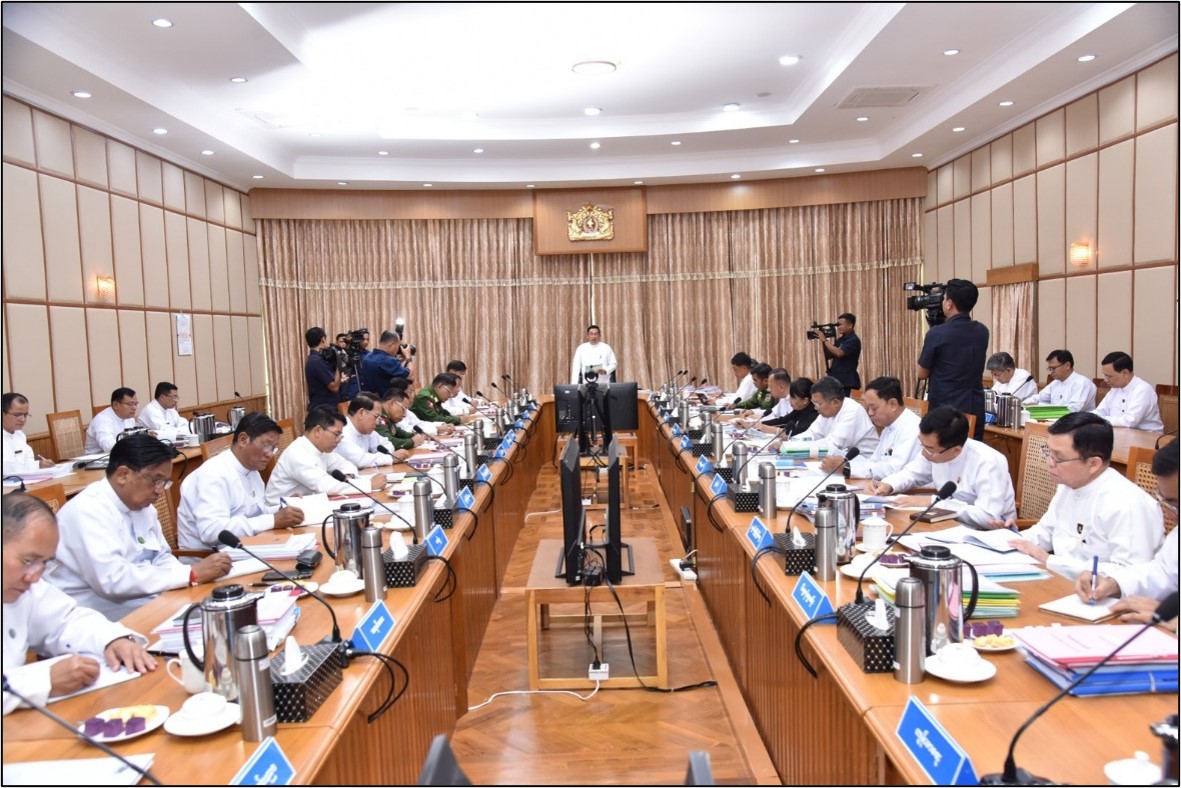
THE Union Government held a 2/2026 meeting at its office in Nay Pyi Taw yesterday afternoon, attended by Prime Minister U Nyo Saw.
Speaking on the occasion, the Prime Minister said that the Forum on the Dawn of a New State will be held in Nay Pyi Taw on 13 and 14 March so that elected Hluttaw representatives can participate in the forum with broader perspectives in political, economic and social sectors with new ideas and landscape to effectively serve the national interest.
He continued that the government has not only faced and resolved the challenges encountered during the political transition processes but has also worked diligently to promote the social and economic development of the people, ensure the stability and peace of the nation, and uphold the rule of law.
In implementing departmental work plans, he noted that it is necessary to formulate and implement the National Planning Law and the regional development plans, which can bring good results to the State and the people.
He stressed that perpetrators of illegal telecom fraud and online gambling enter Myanmar through various methods, often from other nations. Such individuals who cross the border illegally are systematically checked along the way, and prompt legal action and repatriation measures are taken in accordance with the law. Combatting illegal trade and preventing and suppressing narcotics is regarded as a national duty, and authorities at all levels have to carry out preventive and awareness-raising measures.
The Prime Minister underscored that the government is actively promoting the development of agro-based industrialisation in the country. In livestock farming, if local chickens, pigs and cattle are bred using modern techniques rather than traditional methods, production can be increased significantly, which will greatly contribute to the region’s food supply.
He highlighted that in implementing MSME (Micro, Small and Medium Enterprise) operations, it is necessary to ensure that substitute products for imports and export goods are produced with high quality and that business operations are carried out more efficiently. MSME enterprises must also work collaboratively to increase their participation and sales in international markets.
Regarding the education sector, he emphasized that efforts must be made to ensure systematic grade-level transitions in basic education and to enable all schools to operate at full capacity. Therefore, it is necessary for teachers to implement modern teaching methods in line with modern standards. Since a Private Education Law has been enacted for private or independently managed schools, responsible authorities must supervise and ensure that these institutions comply with the law and its regulations.
In the health sector, the Prime Minister spotted that it is necessary to implement projects that enhance healthcare services and raise the life expectancy of the people.
In every town and village, he added that it is necessary to designate and maintain green zone areas, give priority to preventing deforestation, and systematically conserve and protect aboveground and underground natural resources as a national duty.
The Prime Minister recounted that due to the recent conflict in the Middle East, which has affected the global fuel supply, the government has issued public announcements urging citizens to use fuel more sparingly to manage the shortage. In accordance with these announcements, ministries and organizations are assisting in monitoring and enforcing compliance, while the people are also cooperating and participating in these efforts.
In order to hold the traditional Thingyan Festival, the Prime Minister pointed out that this year, the aim is to celebrate the traditional Thingyan Festival more fully. At this time, it is possible to prioritize and organize walking-style Thingyan celebrations appropriate for the current circumstances.
Union ministers discussed their efforts in implementing relevant sectors and plans.
The Prime Minister coordinated their discussions and presentations before giving a concluding remark.
Union ministers and officials in person attended the meeting, while chief ministers of regions and states joined the meeting through videoconferencing. — MNA/TTA