
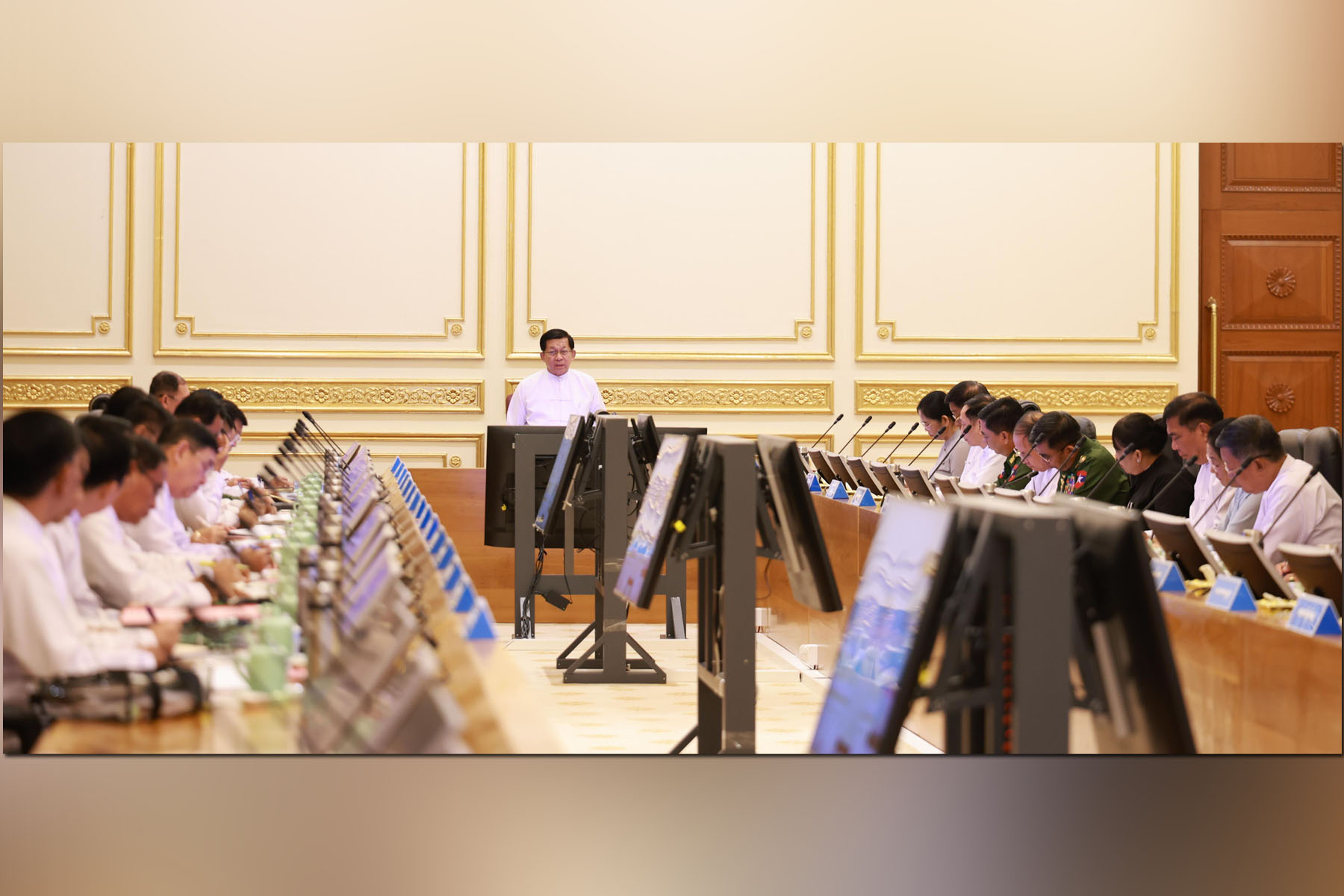
The Union Government meeting, held at the Office of the President in Nay Pyi Taw yesterday afternoon and attended by President U Min Aung Hlaing, discussed efforts to expand domestic production, broaden the tax base to boost national revenue and prepare for by-elections scheduled for April next year.
Vice-Presidents U Nyo Saw and Nan Ni Ni Aye, Union ministers and officials attended the meeting, while chief ministers of regions and states participated via videoconferencing.
In his address, the President said traditional Tazaungdine Festival celebrations had been held across the country, including the Nay Pyi Taw Council Area, in accordance with Myanmar’s cultural traditions and customs. The celebrations included lighting ceremonies, hot-air balloon launching competitions, Mathoe golden lotus robe weaving competitions and various entertainment programmes.
He said such celebrations represented the government’s efforts to preserve and pass on the traditional cultural heritage and national identity of the majority Buddhist population. The government had a responsibility to take the lead in preserving the country’s culture and national identity while respecting the religious beliefs, traditions and customs of people of other faiths. Followers of all religions should uphold and practise the teachings of their respective faiths, he added.
Regarding the case brought against Myanmar by The Gambia, the President referred to the judgment delivered by the International Court of Justice (ICJ), describing the case as a one-sided accusation against the country. He said Myanmar had actively participated in the court proceedings over the seven years since the case was filed, submitting substantial factual information, records and evidence through written and oral arguments. He said the term “genocide” had seriously affected the country’s reputation.
As the country’s leader, he considered himself primarily responsible for all matters occurring in the country and would not accept any actions that undermined the nation. Regarding the ICJ’s decisions, he said Myanmar would take the actions appropriate for a responsible country but would not comply with requirements it considered inappropriate.
On ASEAN relations, he said the ASEAN Charter and policies had been signed and agreed upon by the leaders of member states and should remain the basis for cooperation as long as they were valid and in force. Myanmar attached particular importance to maintaining friendly relations with all countries and would continue engaging with ASEAN member states in accordance with the Charter. He also stressed that member states should respect the ASEAN Charter, one another’s sovereignty and existing laws.
On economic matters, he said some people were holding foreign currencies instead of investing in domestic production, exports and imports, attributing rising commodity prices and exchange rates partly to currency speculation. Exchange rates should remain at appropriate levels, while efforts should be made to ensure affordable food for low-income earners, uninterrupted operations for manufacturers, increased incomes for farmers and livestock breeders, and improved living conditions for civil servants.
He instructed relevant organizations to facilitate production activities and called on regional and state governments to closely supervise efforts to expand domestic industries. Approximately 70 per cent of Myanmar’s population lived in rural areas, while around half of the population was engaged in agriculture, livestock breeding and fisheries, he said.
He urged officials to promote livestock farming by producing animal feed from locally available agricultural by-products, including rice bran, broken rice and maize. Relevant ministries and chief ministers should ensure the effective implementation of agricultural, livestock and manufacturing activities. He also called for systematic plans to expand the breeding of layer and broiler chickens, pigs, goats, cattle and fish to improve food supplies.
He said increased production was essential for generating marketable goods and export earnings, which would contribute to national economic growth. Rather than relying on exports of above-ground and underground natural resources, Myanmar should focus on developing domestic industries and exporting products manufactured locally, which would bring greater long-term benefits to the country.
The government has continuously supported micro, small and medium-sized enterprises (MSMEs), and the economy would develop if people across the country engaged in productive work. He urged regional and state chief ministers to give priority to expanding domestic production.
Regarding rice production, one of Myanmar’s major export sectors, he said efforts under the initiative “A New Era for Myanmar Pawsan Rice” had resulted in the country winning the World’s Best Rice Award for the second time. He stressed the need to select and cultivate high-quality rice varieties suited to local conditions to maintain the quality of Myanmar’s rice exports.
Regarding government revenue, he said efforts to finance national development projects should focus on expanding the tax space rather than increasing tax rates. Broadening the tax space would increase state revenue and help meet requirements such as civil servants’ salaries and other expenditures.
He added that the government was considering salary increases for civil servants and systematically assessing various possible scenarios. Any decision to raise salaries would require comprehensive calculations taking into account employees in MSMEs, workers in factories and industrial establishments, and pensioners. Relevant committees should continue conducting systematic assessments to support national economic growth, he said.
The President also said the Union Election Commission was making preparations to hold by-elections in April next year. He instructed responsible officials to make comprehensive preparations to ensure accurate voter lists and security in the townships where the by-elections would be held.
He stressed the need for collective efforts to ensure the successful conduct of the by-elections, including ensuring the accuracy of voter lists and the proper and systematic use of Myanmar Electronic Voting Machines (MEVMs).
Following the address, Union ministers presented reports and discussed matters relating to their respective sectors. The President then gave necessary guidance on the matters raised before concluding the meeting. — MNA/ST


