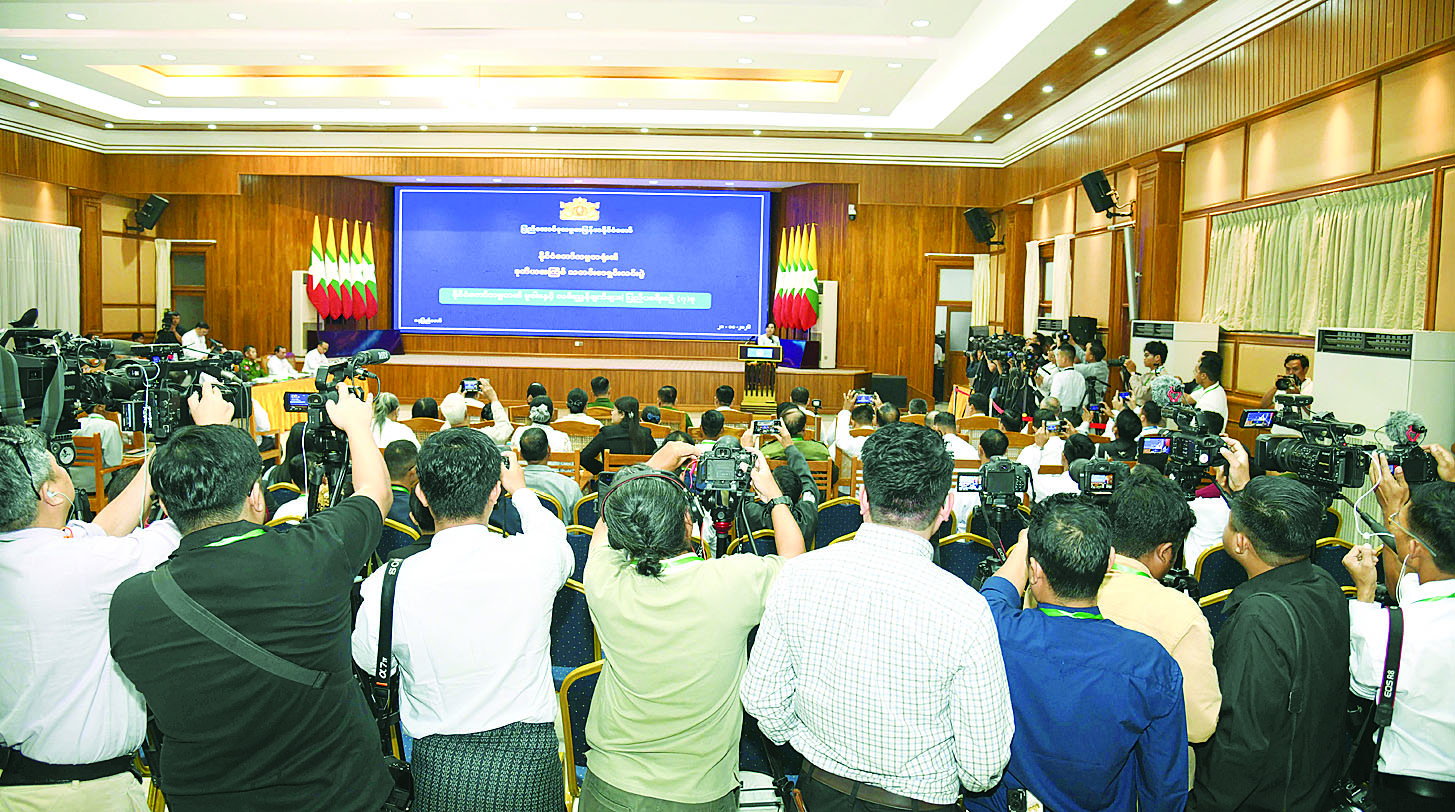
The second press conference of the Office of the President was held at the Multi-purpose Hall of the President’s Office yesterday afternoon, during which Dr Khine Khine Soe, spokesperson at the Office of the President and Deputy Minister, provided clarifications on the policies and priority tasks of the Government.
At the presentation, she stated that the two political objectives were reaffirmed, while the two national objectives of ensuring a prosperous nation and food security would also be incorporated into every speech and pursued as national goals. Regarding peace, every possible effort would be made to achieve lasting peace during the government’s term. The Government would continue along the path of the Nationwide Ceasefire Agreement (NCA) and pursue national reconciliation as its peace policy.
She explained that upgrading railway infrastructure, modernizing railway carriages and renovating railway sections would be undertaken as priority tasks. As importing railway carriages from abroad involves high costs, efforts are being made to enhance domestic production capacity to manufacture railway carriages locally. Regarding the energy sector, a policy has been adopted to give priority to the development of renewable energy. In the telecommunications sector, the 5G system is being tested in Nay Pyi Taw and Yangon, and if the trials prove successful, it will be expanded nationwide.
Regarding the economic sector, under the theme of economy, agriculture, livestock breeding and food security, various measures are being implemented on the ground to increase domestic production, reduce the trade deficit and promote import substitution. To support micro, small and medium enterprises (MSMEs), the President personally inspected MSME businesses in detail during all his domestic trips. As locally produced raw materials are currently being exported mainly in their unprocessed form, resulting in lower earnings, another policy objective is to manufacture value-added finished products domestically and export higher-value products.
Regarding foreign investment and employment opportunities, the President himself has been taking the lead in promoting these areas. During seven of his nine overseas visits, economic forums were held to invite foreign investors and secure investment commitments. Domestically, extensive efforts are being made to review, amend and discuss the necessary laws, policies, guidelines and procedures to create a favourable environment that facilitates and streamlines investment. With regard to domestic production and investment policies, guidelines have been issued to ensure that products are affordable and of good quality, while encouraging large-scale production at low profit margins.
More than 13 million acres of monsoon paddy and over two million acres of summer paddy are currently grown. Therefore, guidance has been given to expand summer paddy cultivation by implementing river-water pumping projects powered by solar energy to ensure an adequate water supply.
Myanmar needs to maintain the quality and brand reputation of its Pawsan rice. While other types of rice fetch only around US$350 per tonne, Pawsan rice commands approximately US$700 per tonne, nearly twice as much. As its premium price could lead to a decline in quality if proper quality control is not maintained, a policy has been adopted to strengthen quality control measures. Policies have also been adopted to expand the cultivation of rubber, bamboo, cotton and coffee.
The priority in agricultural development and crop expansion is to establish an industry sector based on Smart Agriculture. Regarding land utilization, if it is found that land allocated for agricultural and livestock farming is being used for purposes other than those originally intended or sold without implementing the designated activities, the land will be repossessed.
Workshops have been held in Magway Region and other areas to promote the expanded cultivation of oil crops, including sesame, sunflower, soybean and groundnut. These workshops have produced outcomes concerning appropriate cultivation methods and the use of high-quality, pure seed varieties. Although edible oil crops, wheat and cotton are produced domestically, they are not sufficiently processed into finished products, resulting in continued reliance on imports. This has led to an imbalance in the country’s foreign exchange trade balance.
In the livestock and fisheries sector, 70 per cent of fish and shrimp products are obtained through natural capture, while only 30 per cent come from aquaculture. While Vietnam’s Gross Domestic Product (GDP) exceeds US$400 billion and is approaching US$500 billion, Myanmar’s GDP currently stands at only a little over US$80 billion. Regarding taxation, the existing tax rates will not be increased; instead, the tax base will be expanded to broaden the scope of tax collection. Efforts to combat illegal trade in border areas will also continue.
Although it is difficult to immediately replace the large number of staff who underwent the DCS, medical universities have been training new professionals over a period of approximately six to seven years. As a result, more than 2,500 newly qualified doctors and over 2,600 nurses have been appointed.
In addition, arrangements are being made to open Polytechnic Schools to provide secondary-level education in industrial, agricultural and livestock-related subjects. Alongside the establishment of industrial and agricultural high schools, efforts are also being made to introduce these subjects at the middle-school level as general knowledge, without requiring students to sit examinations in them.
Regarding standard schools, only about 10 per cent of Myanmar’s more than 50,000 basic education schools currently meet the standard-school criteria. Although it is not yet possible to upgrade all schools simultaneously, important levels and facilities will be improved gradually, step by step during the five-year term.
Regarding foreign policy, it was reaffirmed that Myanmar would continue to pursue an independent, active and nonaligned foreign policy in accordance with the Five Principles of Peaceful Coexistence. As a member of ASEAN, Myanmar would also continue to maintain friendly relations with all ASEAN member states.
Regarding the sports and cultural sectors, two Art Centres are also being constructed in Yangon and Mandalay, with efforts being made to complete them and promote the development of the arts sector. At present, forest coverage in the country stands at just over 40 per cent, and efforts are being directed towards increasing it to 50 per cent. Furthermore, excessive emphasis on economic development could adversely affect the ecosystem. Therefore, efforts will be made to maintain a balance between ecology and the economy (Ecology and Economy Balance).
Furthermore, five guiding principles for rural development have been adopted and are being implemented, while the fight against narcotic drugs is being carried out as a national responsibility. Regarding online scams and online gambling activities, a Zero Tolerance policy will be strictly enforced, with no leniency, and effective action will be taken against those involved. With regard to natural disasters, a policy has been adopted to ensure that rehabilitation and reconstruction works are completed on time to the greatest extent possible.
The country’s GDP currently stands at just over US$80 billion, and efforts are being made to increase it to US$98 billion within this year. Regarding external debt, the amount, which stood at US$12 billion before 2021, has been gradually reduced through repayments and now stands at US$8.5 billion. In the edible oil sector, efforts will be directed towards achieving domestic self-sufficiency within five years, with the ultimate goal of reaching a level at which imports are no longer necessary.
In terms of railway upgrades, efforts are being made to enable trains to operate at speeds of 70-80 kilometres per hour. Regarding the electricity sector, plans have been made to increase electricity generation capacity to more than 5,000 megawatts to address the power outages currently affecting the public, particularly the difficulties experienced during periods of extreme heat associated with El Niño weather conditions. Further details of these plans will also be explained in due course. Furthermore, concerning the peace process, arrangements have been made to convene the Union Peace Conference in 2028, as stated by the President. Detailed information will be announced at a later date.
Summarizing the President’s individual overseas visits, during his visit to Laos, discussions focused on strengthening diplomatic and strategic partnership relations, maintaining stability in border areas, addressing cross-border issues, and promoting cooperation in trade, transport and energy sectors. Laos also expressed its full support for regional cooperation and Myanmar’s full participation in ASEAN in the normal manner.
During the visit, agreements were reached on establishing a Sister City relationship between Nay Pyi Taw and Vientiane, jointly conducting a feasibility study on hydropower development in the Mekong River Basin, and enhancing labour cooperation for Myanmar workers in Laos. Discussions are also underway on expanding air services between Kengtung and Luang Prabang.
Furthermore, during the visit to Thailand, an agreement was reached to exchange information to combat online gambling, narcotic drugs and human trafficking in border areas. In the environmental conservation sector, considerable progress has also been made in addressing transboundary haze pollution, with follow-up implementation measures continuing after the visit. A Memorandum of Understanding (MoU) on the conservation of water quality in the Namkhok River was also signed. Discussions were also held on increasing bilateral trade volume to US$12 billion.
Regarding the visit to Russia, a total of 12 intergovernmental (G2G) Memoranda of Understanding (MoUs) and several business-to-business (B2B) agreements were successfully signed during the visit. Particular emphasis was placed on cooperation in the energy and higher education sectors. Myanmar is collaborating with Russia to enable a Myanmar astronaut to be sent into space in 2028, and four MoUs on space technology were successfully signed. Furthermore, discussions were held on the construction of an LNG plant in Dawei to supply the domestic market and export LNG to neighbouring countries.
Regarding the visit to Belarus, Belarusian investment in various industrial sectors is expected. In addition, the Myanmar-Belarus Cooperation Roadmap for the three years from 2026 to 2028 will be implemented in accordance with the established framework and schedule.
During his visit to Vietnam, agreements were reached on cooperation in various sectors, including energy, information technology (IT), agriculture and livestock breeding, and digital technology, and several Memoranda of Understanding (MoUs) were successfully signed.
Regarding the visit to Cambodia, an agreement was reached to continue implementing the “Two Countries, One Destination” initiative in cooperation with Cambodia, a country with a well-developed tourism industry, by establishing a Sister City relationship between Bagan and Siem Reap to promote tourism between the two countries. Discussions were also held on the possibility of operating direct flights between the two cities.
Regarding the visit to Malaysia, extensive discussions were held on Malaysia’s strong support for Myanmar’s approach and the path it is pursuing within ASEAN, known as the “Myanmar Way”, among ASEAN member states. In addition, discussions were held with Malaysia on logistics, port operations and the steel industry. Both sides also agreed to promote cooperation through government-to-government (G2G), business-to-business (B2B), people-to-people and think tank-to-think tank initiatives. Notably, a separate discussion between think tanks from the two countries was successfully held. It was also observed that Malaysia had expressed interest in making investments in Myanmar. One of the most significant achievements of the visit was the successful repatriation of more than 8,000 Myanmar nationals from Malaysia. In the final repatriation operation, a Myanmar Navy vessel was dispatched to bring back 1,476 Myanmar nationals.
There are major strategic projects that were discussed during the overseas visits. In cooperation with China, long-term strategic plans are being pursued in the fields of space and satellite technology, including satellite launches, while cooperation with Russia is underway to send a Myanmar astronaut into space. In the energy and electricity sectors, the Mekong hydropower project, the construction of a liquefied natural gas (LNG) plant and the establishment of a nuclear power plant are major strategic projects of great importance to the country’s development.
Regarding the regional trade route, she continued that the East-West Economic Corridor, proposed by the President, aims to connect Vietnam, Laos, Thailand and Myanmar, providing access to the Indian Ocean. The proposed route has been discussed and presented at meetings with Russia, Belarus, ASEAN member states, China and India. India has also expressed interest in exporting its goods through this route. As Myanmar is strategically located at a central junction, the President has proposed ways to develop trade routes passing through Myanmar.
She also highlighted the electricity distribution, saying that in 2026, hydropower remains the main source of electricity, while the use of natural gas and solar energy is still limited. By 2030-2031, the government plans to increase solar power generation alongside hydropower significantly. The use of natural gas and coal will also be increased in a balanced manner.
Following the remarks, the President’s Office Deputy Minister and Spokesperson Dr Khine Khine Soe, permanent secretaries, directors-general and officials from relevant ministries responded to questions raised by local and foreign journalists.
For the question raised by U Moe Hein from Thuriya Naywun Journal about the current state of Myanmar-US relations, the deputy minister confirmed that Myanmar had resumed engagement with the United States. So far, three meetings had been held with representatives of relevant organizations in Singapore, Myanmar and Japan. She also explained that a recently announced strategy for Myanmar issued by the US Department of State included four objectives. The first objective was to address transnational threats originating from Myanmar. She said this was in line with Myanmar’s policy, as the country was applying a zero-tolerance approach and taking effective action against online scams and transnational crimes. The other objectives included reducing the trade deficit, supporting peace initiatives, and expanding engagement with Myanmar to increase regional influence.
She stated that just as the United States acts in accordance with its national interests, Myanmar, as a sovereign country, would also prioritize its national interests and cooperate on matters that could bring mutual benefits and create a win-win situation for both sides.
Regarding peace efforts, she said Myanmar would firmly pursue approaches that were appropriate to its own circumstances in any cooperation efforts. She added that lifting sanctions and promoting cooperation could greatly help improve people’s living standards and national development. She confirmed that discussions between the two sides were taking place and that Myanmar was ready to cooperate for mutual benefit.
U Okka from Myanmar Hard Talk asked whether there were plans to change the names of states and whether a national convention might be held.
The Deputy Minister clarified that changing state names would not require an amendment to the 2008 Constitution, as Section 9(c) already provides for such changes. Therefore, there would be no need to convene a national convention for this purpose.
Daw Khine Sabai Oo from Hein Thitsa Journal asked about crime and efforts to uphold the rule of law in the country. A responsible official from the Ministry of Home Affairs replied that relevant departments were working together to address challenges that could affect national stability, the rule of law and the socioeconomic lives of the people.
U Nay Lin from Voice of Myanmar asked about the progress of peace efforts and measures to combat corruption. In response, the deputy minister said that peace could not be achieved within a short period. However, the President had pledged to work towards achieving lasting peace during the government’s five-year term. All organizations, including the KIA, had been invited to participate in peace talks.A responsible official from the Anti-Corruption Commission added that the commission was carrying out preventive measures, investigations and public awareness activities in accordance with the relevant laws and regulations. The commission was also implementing the four-digit Short Code system under the Public Feedback Programme (PFP), allowing the public to provide feedback on public services. In addition, it was conducting Corruption Risk Assessments (CRA) to identify and address possible corruption risks.
Then, Saw Chit Naing from Kin Htauk News Journal asked how the authorities would respond to activities by the KNU, KNLA and PDF groups, which were alleged to be aimed at damaging friendly relations between Myanmar and Thailand. A responsible official from the Directorate of Public Relations and Psychological Warfare responded that Myanmar placed special importance on relations with neighbouring countries in accordance with its independent, active and non-aligned foreign policy and the principles of peaceful coexistence. The official stated that the KNU, KNLA and PDF groups linked to the NUG and CRPH, together with some media outlets supporting armed groups, had been carrying out activities intended to undermine Myanmar-Thailand friendship. An official statement on the matter had already been issued on 3 November.
The official concluded that Myanmar and Thailand were strategic partners and that neither country would take any action that could violate the sovereignty of the other. Relations between the two armed forces remained friendly and strong.
U Htoo Maung Maung from Union Politics News Agency asked whether the current government had any alternative policies or processes to be implemented alongside the Nationwide Ceasefire Agreement (NCA) in pursuing the peace process. He also asked about cases in which certain groups were expanding their territorial control beyond the provisions of the Constitution. The response stated that there was no alternative peace process and that efforts would continue through the NCA framework. Although there were cases of territorial expansion beyond the Constitution, these issues would be addressed through negotiations under the NCA.
U Myat Khine from Popular News Agency asked what factors determined the ups and downs of Myanmar’s political situation and sought the President’s position on the International Court of Justice (ICJ) ruling. In response to the first question, the deputy minister said Myanmar was a sovereign country, and its political situation did not depend on any foreign power. Rather, it depended on the unity and resilience of its own people.
Regarding the second question, the ICJ case, she said Myanmar had been addressing what it considered to be unjust accusations over the past seven years in line with international standards and had made every effort to comply with the provisional measures. She noted that the ruling issued the previous day had received the support of nine of the 15 judges, while six had disagreed. Therefore, she said, it was not a unanimous decision and was unfair. The 186-page court ruling and the 269-page opinions of the judges would require further legal examination. She also mentioned that three world leaders had held discussions the previous day. She also stated that the United States had issued a statement saying that the ICC and international organizations should not abuse their jurisdiction. The United States was also reviewing the ICJ ruling concerning Myanmar and had said that it should not be used for political purposes.
U Thura Aung from Top Phoenix Journal asked about the Hanthawady International Airport Project. An official from the Ministry of Transport replied that a 15-member Steering Committee, chaired by the Vice-President, had been formed on 23 September 2026 to lead the project. The committee’s first meeting was scheduled to be held in December. Details regarding the project’s commencement and implementation policies would become clear after the meeting.
U Win Oo from New History for People (NHP) News Agency asked about assistance being provided to internally displaced persons (IDPs) facing difficulties and measures being taken to enable them to return to their places of origin. The deputy minister responded that, during the one year from January to December 2025, the Ministry of Social Welfare, Relief and Resettlement had provided a total of K135.402 billion in assistance to displaced people identified through data collection, at a rate of K20,000 per person per month. She added that K1 billion had also been provided to support five basic food items for registered displaced people in Yangon Region. In addition, the Government was carrying out rehabilitation activities in the respective regions and states with funding exceeding K30 billion.
Daw Khet Hnin Su from Public Echo Online Media asked what measures the Government had taken to support the livelihoods and employment opportunities of women and children who had lost their family breadwinners due to armed conflicts. The deputy minister responded that the Ministry of Social Welfare, Relief and Resettlement was taking the lead in ensuring that children from families who had lost members could continue their lives without disruption to their education and healthcare, while also ensuring their safety and well-being. She said the Department of Social Welfare was providing care for children who had lost their parents, orphans and children in need of protection at eight childcare centres. Children aged 10 and above were being provided with education until they completed primary school. For children aged 12 and above, training schools had been opened to provide both general education and vocational training. She added that, under the Social Protection Strategic Plan, efforts were being made to connect children with resources available in their communities so that they could receive assistance for education, healthcare and other essential expenses.
An official from the Directorate of Public Relations and Psychological Warfare also outlined the benefits provided to families of military personnel who had died while performing operational duties. These benefits included promotion in rank for eligible family members, free medical treatment, educational grants and special family pensions amounting to 70 per cent of the deceased service member’s last drawn basic salary, payable to eligible dependents regardless of the service member’s age. In addition, eligible legally recognized or officially registered children were entitled to child allowances calculated according to a prescribed percentage of the deceased service member’s last drawn basic salary, and monthly education allowances from the date they started school. Other benefits included death compensation and condolence payments, free housing, honorary titles and assistance in finding employment. The official said the relevant benefits were being provided to eligible family members in accordance with established procedures.
U Tun Lin Htet from Branded Myanmar Agency asked whether the President planned to hold a national-level education forum to promote the education sector and whether the Government would publicly announce its roadmap and timeline for education reforms. The deputy minister replied that the Government planned to increase the share of the budget allocated to education to 10 per cent, 15 per cent and 20 per cent in successive financial years during its term.
Daw Myo Pa Pa Phyo Wai Lwin from Queen for Peace News Agency asked about the provision of healthcare services to the public at public hospitals. The deputy minister responded that difficulties could arise when the number of patients was disproportionate to the number of doctors and nurses. However, efforts were being made to recruit and replenish healthcare personnel as quickly as possible.
An official from the Ministry of Health also said that the ministry currently oversees 1,180 people’s hospitals, which provide treatment to about 30,000 inpatients and between 40,000 and 45,000 outpatients every day. The official explained that the healthcare sector had experienced a loss of tens of thousands of staff members. Although efforts had been made to recruit them again, only a few thousand had returned, resulting in a shortage of human resources.
U Zaw Min Naing from Myanmar Public Press News Agency asked about measures to ensure fair prices for farmers’ crops and create employment opportunities for workers. An official from the Ministry of Agriculture, Livestock and Irrigation responded that, for this year, the basic reference price has been announced through newspapers at K1,350,000 per 100 baskets of paddy. Arrangements are also being made to set basic reference prices for all other major crops.
Similarly, an official from the Ministry of Labour said that the Government was cooperating with relevant ministries to conduct pre-employment vocational and skills training courses to equip workers with skills suited to workplace requirements.
U Myo Min from White Balance News Agency asked how the Government would address the drug problem, as drug control efforts involving government departments and officials had not yet brought significant reductions in some areas. The deputy minister responded that drug-related arrests and legal action were being carried out continuously. An official from the Ministry of Home Affairs added that from January to October 2026, authorities uncovered and arrested suspects in 5,126 drug-related cases and took legal action against 7,458 individuals. The official also said that Operation 42 was being implemented to further identify and prevent drug production, storage, transportation and trafficking.
U Kaung Htet Kyaw from TV Asahi asked whether there were plans to release Daw Aung San Suu Kyi soon, following arrangements in recent months that allowed her to meet the International Committee of the Red Cross (ICRC) and speak with her son by telephone. He also asked for the Government’s views on international calls for her release. The deputy minister responded that Daw Aung San Suu Kyi had been convicted and taken legal action against her under criminal laws relating to election vote fraud, corruption and mismanagement. Regarding a possible release, she said that, as the President had stated, the future could not be predicted with certainty. Therefore, no definite announcement could be made at this stage. Any consideration would depend on Daw Aung San Suu Kyi’s actions and the relevant circumstances, she continued.
U Htay Aung from Orchid News Agency asked about action being taken against the falsification of household registration documents and national registration cards. The deputy minister responded that Myanmar was currently transitioning to the e-ID system, with more than 99 per cent of personal information already entered into the system. Around 15 million people had been issued e-ID numbers. She added that once the e-ID system was fully completed, document forgery would be significantly reduced.
Nan Pyae Zin Aung from Nikkei Shimbun asked whether policymakers had been informed about delays in factory operations, including those in the Thilawa Special Economic Zone, caused by insufficient import licences for machinery and spare parts. She also asked what measures were being taken to address the issue.
An official from the Ministry of Commerce added that at present, applications for import permissions were being submitted to the Foreign Exchange Supervisory Committee after reviewing foreign currency earnings from exports and the country’s foreign currency requirements.
U Htet Naing Zaw from BBC asked whether Myanmar accepted the International Court of Justice (ICJ) ruling. The deputy minister replied that, throughout the past seven years, Myanmar had fully complied with the Court’s procedures and provisional measures without fail. She said the latest ruling was not unanimous among all 15 judges, as it had been adopted with nine votes in favour and six against. She described the decision as unfair. She added that the 186-page Court ruling and the 269-page opinions of the judges would first be examined and reviewed in detail. Only after that would Myanmar officially announce how it would proceed from the standpoint of a sovereign state.
An official from the Ministry of Foreign Affairs also said that Myanmar had signed the Genocide Convention in good faith. Myanmar would study the differing opinions included in the ruling and determine its next steps based on the country’s actual situation, national security, territorial integrity and the protection of its sovereignty.
Regarding ASEAN affairs, the deputy minister said Myanmar continued to maintain friendly relations with other member states as an ASEAN member. Bilateral relations with other countries were also progressing smoothly. However, she said questions remained as to whether the decisions of ASEAN Summits and the FivePoint Consensus genuinely represented the consensus of all member states. She added that Myanmar would review and make decisions on these matters on a case-by-case basis. — MNA/TTA/KTZH