
Education and human resource development are shared national responsibilities that require the collective efforts of the government, educators, parents, relevant departments, and all sectors of society.
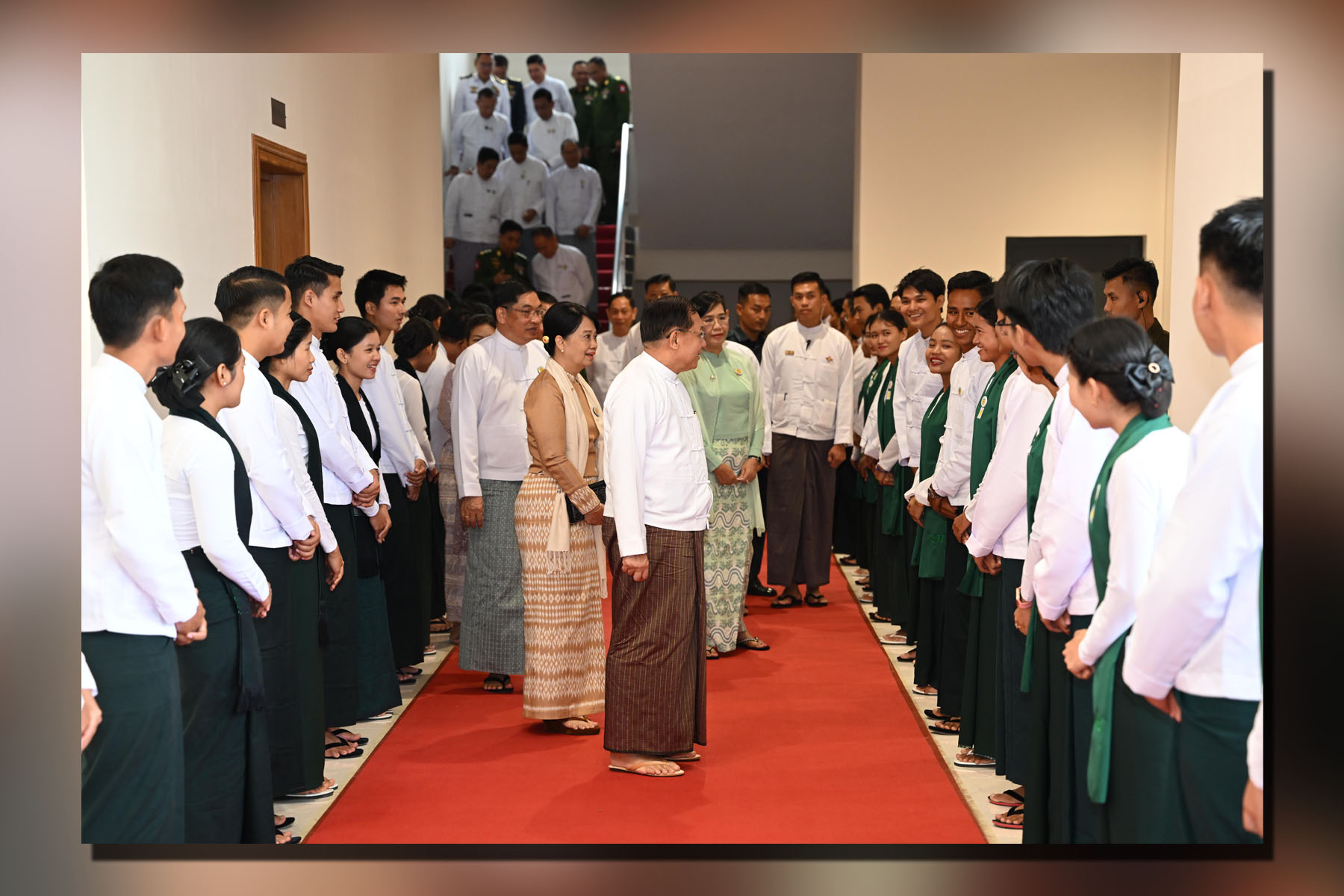
Universities of Education must also emphasize improving the quality of teacher education, expanding research activities, promoting digital transformation, and producing teachers who are well-prepared for the era of artificial intelligence (AI), said President of the Republic of the Union of Myanmar U Min Aung Hlaing at the ceremony to give guidance to the youths who graduated from the Yangon University of Education and Sagaing University of Education at Naypyitaw State Academy in Nay Pyi Taw yesterday morning.
At the meeting with the youths, the President provided guidance, underscoring that these universities need to continue their efforts to serve communities and strengthen international cooperation.
He noted that education extends far beyond teaching and awarding academic qualifications; it plays a vital role in improving individual lives and shaping the nation’s future development.
The President stated that students learn not only the academic knowledge contained in textbooks but also emulate their teachers’ behaviour and speech, and learn from their discipline, sense of responsibility and moral values.
He underlined that the Government has been treating the education sector as a fundamental investment in national development and has been placing special emphasis on its advancement. It has been making concerted efforts to expand educational opportunities from basic to higher education, improve the quality of education, expand technical and vocational education and training, ensure that teaching and learning are aligned with workplace requirements, enhance the qualifications and capabilities of educators, and promote the all-round development of young people.
As part of efforts to increase investment in the education sector, the President said the government plans to allocate 6.92 per cent of the State budget to the Ministry of Education in the 2026-2027 financial year.
Including education-related expenditures by other ministries, total spending on the education sector is planned to reach 9.22 per cent.
Furthermore, he explained that the Government aims to increase the budget allocation for the Ministry of Education to at least 10 per cent in the 2027-2028 FY, raise total expenditure on the entire education sector to 15 per cent in the 2028-2029 FY, and increase it to 20 per cent during the Government’s five-year term.
The President highlighted that increasing investment in education goes beyond constructing schools and buildings; it also involves investing in improving teachers’ qualifications and capabilities, providing teaching and learning materials, creating a conducive learning environment for students, and developing human resources for the future.
He underscored that emphasis is being placed on creating learning opportunities for all school-age children and enabling those who have discontinued their education to resume their studies and rejoin the learning community while the KG+9 education system is being implemented in the basic education sector.
On the other hand, the President detailed that arrangements are being made for students to learn basic industrial, agricultural and livestock techniques starting from the middle school level. Meanwhile, more high schools where students can learn the aforesaid subjects are being established.
The President stated that efforts are being made to establish three Polytechnic Universities this year in addition to plans to open polytechnic schools in regions and states in the 2027-28 academic year.
He clarified that the Government plans to conduct basic vocational training courses for those who have duly fulfilled their military service obligations and those who had to discontinue their education at the primary, middle or high school levels for various reasons.
The President outlined five key points for the graduates to strictly observe in their work. These are: they should continuously improve their professional knowledge and teaching experience; they should put student-centred teaching and learning into practice; they should uphold professional teaching ethics and set good examples; they should demonstrate cooperation and a strong sense of responsibility in the workplace; and they should respect and abide by laws, bylaws, rules and regulations.
On behalf of the graduates, a female graduate spoke words of thanks.
Two students respectfully presented the commemorative gift of their graduation from two universities to the President.
Also present at the ceremony were Vice-Presidents U Nyo Saw and Nan Ni Ni Aye, Commander-in-Chief of Defence Services General Ye Win Oo, Union ministers and Union-level dignitaries, senior Tatmadaw officers from the Office of the Commander-in-Chief, the commander of the Nay Pyi Taw Command, deputy ministers, rectors and faculty members. — MNA/TTA


