
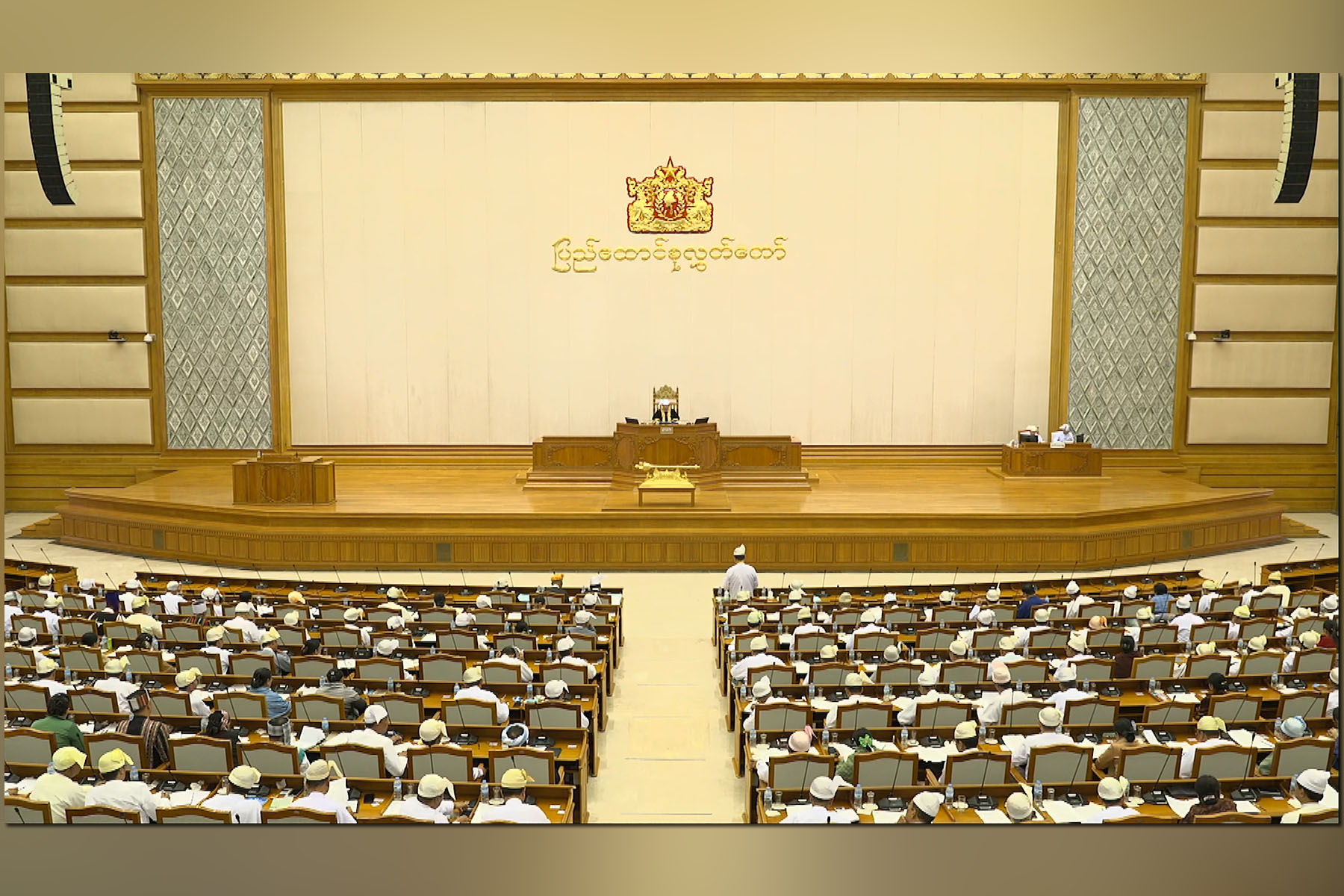
THE fifth day of the third regular session of the Third Pyidaungsu Hluttaw was held in Nay Pyi Taw yesterday morning, with 533 of 560 eligible representatives attending, representing 95.18 per cent.
Speaker U Aung Lin Dwe first announced that the meeting had started.
The parliament approved the appointment of Lt-Gen Yar Pyae as Union Minister for Defence and Dr Ko Ko Lwin as Union Minister for Social Welfare, Relief and Resettlement, following nominations by the President.
Deputy Minister for Legal Affairs Dr Htein Lin Oo then explained the need to extend the validity period of Ordinance 1/2026, which declared a state of emergency in 58 townships, to restore normal administration, community peace and stability, and the rule of law. The Speaker invited representatives to register for discussions on the proposal.
Representatives also discussed the agreement between Myanmar and Cambodia on avoiding double taxation on income and preventing tax evasion.
Sagaing Region Representative Daw Theingi Win Shwe supported the agreement, saying it would help prevent tax evasion and tax-related misconduct, protect taxpayers’ rights, ensure fair taxation and improve transparency, business confidence and investment relations between Myanmar and Cambodia.
Mon State Representative Daw Soe Soe Myint also backed the Double Taxation Agreement (DTA), noting that it would balance tax relief with the protection of national tax revenues while promoting bilateral trade, services, investment and economic growth.
Dr Shwe Pyi Soe from the Dagon Myothit (Seikkan) Constituency said double taxation could reduce personal income, discourage investment, drive skilled workers away and hinder economic growth. He strongly supported the agreement to prevent double taxation and tax evasion.
U Ye Htut Aung from the Minhla Constituency and Daw Myint Sanda Aung from the Myaungmya Constituency also discussed the agreement.
Regarding the discussion, Deputy Minister for Finance and Revenue U Kyaw Htin said the Double Taxation Agreement between Myanmar and Cambodia aims to promote bilateral trade, investment and economic opportunities. He said the agreement would provide a stable tax environment for investors, prevent double taxation, strengthen cooperation between tax authorities to combat tax evasion and improve diplomatic relations.
He added that, once approved by the Hluttaw, both countries would exchange instruments of notification in line with their respective laws. The agreement would then be implemented in Myanmar through official notifications, publication in the Myanmar Gazette and posting on the Internal Revenue Department’s website.
He urged the Pyidaungsu Hluttaw to approve the agreement under Section 108(a) of the Constitution and Section 59 of the Pyidaungsu Hluttaw Law.
The Speaker sought the approval of Hluttaw and announced the approval.
The representatives then discussed the submission of the instrument of ratification for the Ninth Package of Commitments on Financial Services under the ASEAN Framework Agreement on Services sent by the President to the ASEAN Secretary-General’s office.
Taninthayi Region Representative U Than Aye(aka) U Tin Oo, supported sending the instrument of ratification for the Ninth Package of Commitments on ASEAN financial services liberalization to the ASEAN Secretariat through diplomatic channels. He said this would complete the liberalization process in relevant sectors, attract more foreign investment and support Myanmar’s economic development.
Dr Kyaw Swe, representing the Taungdwingyi Constituency, said the agreement could promote foreign investment and economic growth. However, he stressed the need to understand the commitments, scope of liberalization, benefits and risks before approval, highlighting that expected benefits alone were not sufficient grounds for a decision affecting the country’s long-term financial interests.
Deputy Minister for Finance and Revenue U Kyaw Htin said Myanmar must complete its domestic ratification procedures within 180 days of signing the agreement. The agreement will take effect the day after the ASEAN Secretary-General notifies other member states of receiving the instrument of ratification.
He explained that the agreement aims to promote trade and cooperation in services among ASEAN members and remove restrictions. Under the ninth package, the Ministry of Finance and Revenue will relieve the insurance sector, while the Central Bank of Myanmar will oversee banking and other financial services.
He said Myanmar has licensed five wholly foreign-owned life insurance companies, three joint-venture life insurers and three joint-venture general insurers, and opened 27 foreign bank representative offices.
The agreement is expected to facilitate financial transactions and investment, attract foreign capital, improve domestic banks’ access to advanced technology and international standards, develop human resources and promote trade through direct payments in the currencies of the two countries.
He also added that the agreement had been submitted to the Economic Committee and the Union Government. If approved by the Pyidaungsu Hluttaw, the Union Minister for Foreign Affairs will sign the instrument of ratification and send it to the ASEAN Secretariat through diplomatic channels. He then explained to approve the submission in accordance with Section 209(a) of the Constitution and Section 25(a) of the Union Government Law.
The Speaker sought the approval of Hluttaw and announced the approval.
Deputy Minister for Finance and Revenue U Kyaw Htin discussed the export credit loans from Belarus’s DBRB and Belinvestbank JSC, submitted by the President and discussed at the Pyidaungsu Hluttaw meeting on 8 October 2026.
He said foreign currency loans carry exchange rate and interest rate risks. To minimize these risks, the government will assess currency stability, benchmark interest rates and repayment periods. As the loans have a maximum term of five years, their exposure to market fluctuations is expected to be lower.
He added that banking arrangements between Belarus and three state-owned banks — Myanmar Economic Bank, Myanmar Foreign Trade Bank and Myanmar Investment and Commercial Bank — were signed in November 2025 and May 2026, with negotiations underway to open bank accounts.
The export credit loans are available in five foreign currencies. The government will check that the currencies and payment channels are not subject to sanctions and ensure that goods and services purchased with the loans meet the country’s actual needs and benefit the public.
As the basic agreements for the export credit loans have been signed, U Kyaw Htin sought Pyidaungsu Hluttaw’s approval in accordance with Section 9 of the Union Budget Law for the 2026-2027 financial year and Section 3 of the Public Debt Management Law.
He also said the proposed loan of K2.1 trillion from the Central Bank of Myanmar for the 2026-2027 financial year would cover any deficit in the Union Government’s deposit account, rather than fund a specific project.
He clarified that the K2.1 trillion was a net borrowing estimate and that no loans had been taken from the Central Bank as of June 2026. The full amount would not necessarily be used. The government would first raise funds through monthly treasury bill and bond auctions and borrow from the Central Bank only if a deficit remained at the end of the month.
He said the borrowing would comply with Section 12 of the Union Budget Law for the 2026-2027 financial year, Sections 3 and 5 of the Public Debt Management Law, and Section 91 of the Central Bank of Myanmar Law. The Ministry of Finance and Revenue would also supervise government departments to ensure effective spending and prevent waste of public funds.
He then sought Pyidaungsu Hluttaw approval for the Union Government’s plan to borrow up to K2.1 trillion from the Central Bank, secured by government treasury bills.
Regarding this case, Deputy Governor of the Central Bank of Myanmar U Thet Tun Aung said the Central Bank would cover the government’s financing needs by purchasing treasury bills at an interest rate of four per cent, under an agreement with the Ministry of Finance and Revenue covering the 2022-2023 to 2026-2027 financial years. The repayment schedule is being discussed under Section 93 of the Central Bank of Myanmar Law.
He said lawmakers had raised concerns about inflation and currency depreciation, stressing the need to coordinate financial and monetary policies. Government borrowing from the Central Bank had declined significantly, with its share of deficit financing falling from 70.81 per cent in 2024- 2025 to 7.82 per cent in 2025- 2026.
He added that further development of the money market and secondary market would help reduce reliance on Central Bank borrowing. The Central Bank is also using monetary policy measures, including adjustments to the minimum cash reserve ratio (CRR) and interest payments on excess reserves, to ease inflationary pressures.
He said the Monetary Policy Committee, which includes the Deputy Minister for Finance and Revenue, holds monthly meetings to coordinate policies. He sought Pyidaungsu approval, in accordance with Section 91 of the Central Bank of Myanmar Law, for the Central Bank to purchase government treasury bills to cover up to K2.1 trillion of the Union Government’s projected deficit in the 2026- 2027 fiscal year.
The Hluttaw announced the approval.
Deputy Minister for Finance and Revenue U Kyaw Htin presented the 2025-2026 Union Budget Annual Report, saying that ordinary revenue collections by Union ministries and organizations nearly met their targets, while capital revenue and debt receipts fell short.
He explained that lower-than-planned capital revenue was mainly due to delays in foreign aid-funded projects. Debt receipts also fell short because loan repayments from departments and borrowers, including COVID-19 relief loans, were not fully recovered. Ordinary expenditure nearly met its target, with lower interest payments on foreign loans and reduced contributions to international organisations. Capital and debt expenditures also fell short due to construction delays, late delivery of power plant spare parts, tender savings, suspended foreign-funded projects and difficulties transferring loan repayments to creditor countries.
He urged ministries and organizations to prepare realistic budget estimates based on revenues and expenditures that could actually be achieved within each financial year. He asked the Pyidaungsu Hluttaw to review and approve the annual report under Section 19 of the Union Budget Law. The meeting will resume on 16 October. — News Team/KTZH


