
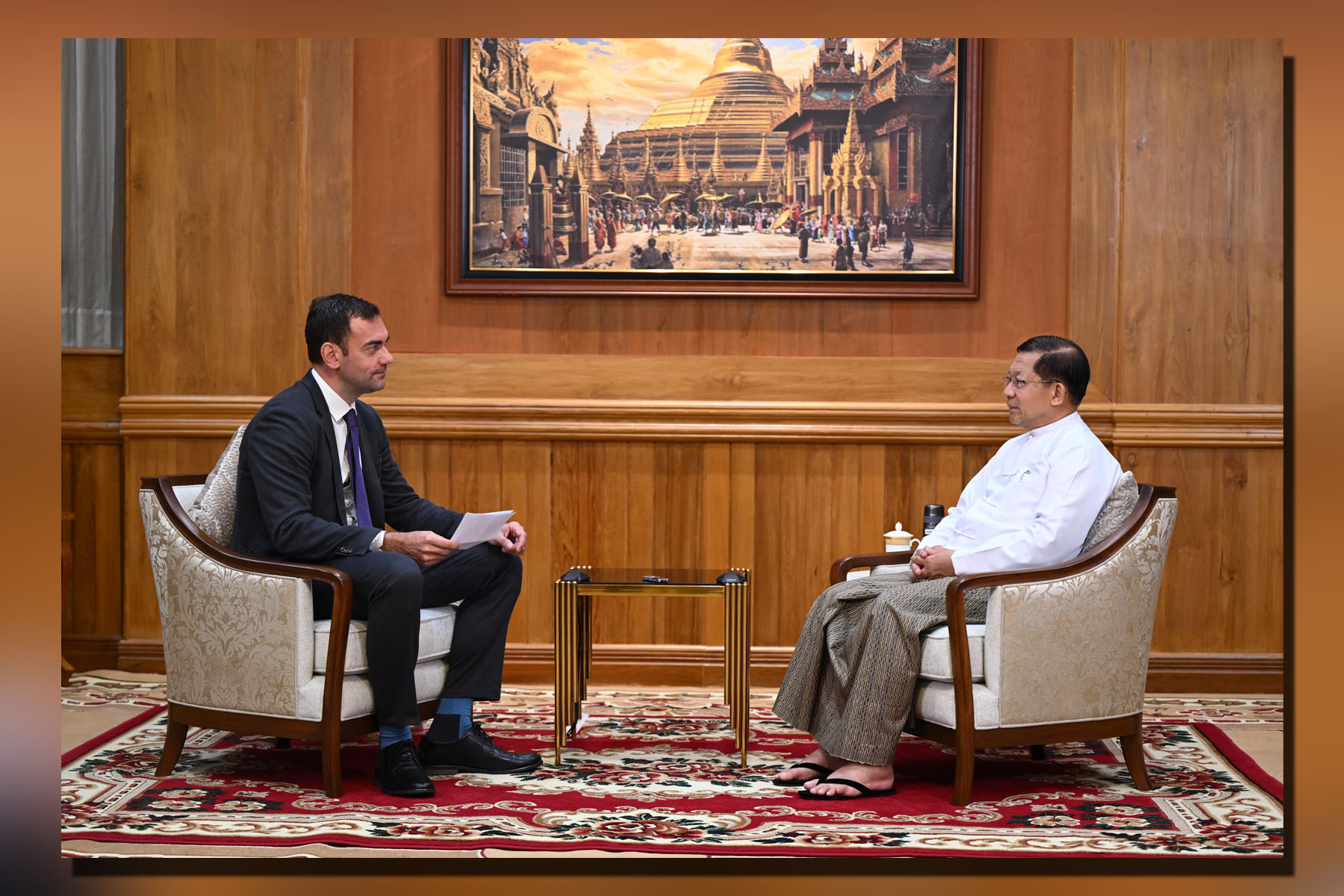
PRESIDENT U Min Aung Hlaing responded to questions from Charlie Campbell, journalist for Time Magazine, at the President’s Office in Nay Pyi Taw on the morning of 28 August.
Time Magazine - I’m very grateful for your time today. I think it is a great opportunity to explain Myanmar’s current situation and many recent ties with the West, especially the US, regarding your presidency, your leadership and your goals in Myanmar. I’m very grateful for your time, and we would be able to talk candidly about some of the issues recently in the country.
President - I’m also very glad to meet with you. To my knowledge, “Time Magazine” is a very famous and straightforward media. That’s why I agree your team today, and this opportunity provides you to explore the current developments of our country. As I learn about Time Magazine, I have a great impression of your media, which is better compared with other Western media. I hope for your kind understanding, as I have a busy schedule, so we can take time to fix the date for this exclusive interview.
Time Magazine - Absolutely, I understand you’re very busy. We’re grateful for your time today. Thank you.
Q - Your Excellency, to kick off, following the election, you’re now Myanmar’s President after serving several decades in the military. How are you adjusting to civilian leadership?
A - For me, it is not hard to adjust to civilian life. I have served in the military for almost five decades, but my parents are civilians.
For your information, all of our family members stay together on the military campus. That is why we are addressed as a family. Even when the military personnel have to serve their obligations, like going to the front combat areas, for example, the families stay behind on the military campus. That means we are already familiar with the civilian side and civilian society. Actually, the military is part of the country. Similarly, family members of the military personnel are part of the people of Myanmar. That is the first point I would like to mention.
Every weekend, the Myanmar military, along with family members, renders public service to support the welfare of civilians, staying very close to civilians. Throughout my military career, I have been very familiar with the civilian side. During my term as Commander in Rakhine and Shan States, I was most responsible for military duties but also for the civilian administration. When the State of emergency was announced in 2021, I served as the Head of Government, and I had to tackle the civilian side.
Regarding your question, I do not need to make significant adjustments to be in harmony with civilian life.
Q - Are you taking a more military approach to leadership in civilian life, or has your leadership approach as a civilian leader changed?
A - It is quite different. Military leadership is quite simple, and it depends on giving orders. But for civilians, we have to use a persuasive and stimulating approach.
I also want to add that the commander spirit is applied during military operations in combat areas. The commander should be strict because everything depends on his orders. Transitioning from military command to civilian leadership is a profound shift, so the commander has to keep in mind the parental spirit for the administrative arrangement. When I shift to the civilian side, I have to remove all the commander leadership and keep in mind the parental spirit when I am working on the civilian side.
Q - I understand. Myanmar remains kept fighting conflicts. What is your plan for bringing the nation to lasting peace? Do you feel that the recent allegations of excess force use by Myanmar military might hamper the process?
A - Peace is extremely important for our country. There have been armed conflicts in our country that we have faced since we regained independence. This is the colonial legacy, the consequences of colonization. During the colonial period, the divide-and-rule policy was practised. Consequently, misunderstandings occurred among national races as well as different political ideologies, which should be solved peacefully in national races of civilian affairs and political affairs. After regaining national independence, we firstly practiced the parliamentary system. After that, we practised a centralized government system for many years. Because of the centralized government system, dissatisfaction in terms of politics emerged amongst the people of Myanmar. After that, we practised a multiparty democratic system in 2011. After the 1988 uprising, we have undergone political transformation since 1988. Gradually, we transformed our political system.
The ethnic groups claim autonomy in terms of politics, and they claim democracy. These two aspects are already included in the 2008 State Constitution. We have been implementing to fulfil these two themes – autonomy and democracy since we transformed into a civilian government in 2011. We make all out efforts to peace talks and the peace process. Eventually, we signed a peace accord, the Nationwide Ceasefire Agreement (NCA), in 2015. It was signed by some ethnic armed organizations and non-state actors. According to the NCA, we have to make some amendments in the Constitution. So, the Government already submitted the amendment to the Parliament. The Parliament discussed it, and accordingly they will amend the Constitution at a certain time. According to the developments that took place in 2021, Myanmar experienced violent attacks. The Myanmar people want democracy; that’s why we successfully held the elections. Within the first 100 days, the new Government invited all the armed groups for peace talks. As of now, more than 4,000 young people have returned to the legal fold and returned to the embrace of their parents. They have already returned to their homes. Mostly are from ethnic armed groups. Most of them are male, and they have poor education. Taking this opportunity, some politicians incited them to become members of their armed groups. It is really heartbreaking to see them fighting in the jungle with arms. Actually, they should be in the classrooms. That is why we consider their future, and we extend an invitation for peace talks with us. So, I am committed during my term of five-year as the President. My focus is mainly on the peace process, and I truly believe this will achieve success.
Q - Your Excellency, international sanctions have frozen hundreds of millions of dollars from Myanmar, targeting you and your family. How does the economic isolation hurt the people of Myanmar, and what concessions have you prepared to seize unlisted?
A - Due to the sanctions, it hurts the banking system, so also foreign currency accounts are restricted for transactions.
Due to the targeted sanctions and restrictions, the first thing is that we have less foreign direct investment in Myanmar. Consequently, we have very few job opportunities. Due to the transaction barrier, it is very difficult to import goods from other countries to fulfil the requirements domestically. It is quite correct that the sanctions have impact to economic sector of the country to a certain extent. For food security, we have food project activities, not too much serious for that but for the productivity status, we find many difficulties due to the sanctions.
Q - Thank you, Mr President. What is your plan as you have developed Myanmar’s economy for the benefit of Myanmar people?
A - As I’ve already mentioned in my previous answer, we are well enough to cover food security. Myanmar intends to become a resilient agro-based country where 70 per cent of the population resides in rural areas. Among them, 50 per cent work in the agriculture and livestock sectors. Therefore, we have the potential to go forward to become an agro-based industry, such as cotton and rubber production industries. Instead of exporting raw materials, we are moving forward to produce more value-added products. As we can produce more, we can improve the socio-economic life of the rural people. The next point is the promotion of micro, small, and medium enterprises (MSMEs), which occupy 90 per cent of the economic sector. During my term, I will encourage MSMEs while accelerating the production of value-added products in Myanmar.
Q - Obviously, the US Government has been quite critical of your government so far. How would you like the Trump Administration to help the people of Myanmar?
A - The United States and Myanmar established diplomatic relations in September 1947, so our diplomatic relationship is approaching 80 years. Historically, our two countries have maintained friendly relations. Although we are geographically about 13,000 kilometres apart, we have had many periods of positive and constructive bilateral relations. However, as Myanmar has gone through different political transitions, our bilateral relations with the United States have also experienced ups and downs. I recall that during the Korean War and the Vietnam War, Myanmar maintained a policy of non-alignment and neutrality. We did not become involved in those conflicts. Myanmar is currently practising a multiparty democratic system, while the United States has a long-established democratic system. Given our shared commitment to democratic principles, we hope that the United States can provide constructive assistance to Myanmar during this period of political transition. In response to your question, we would welcome kind assistance from the United States in promoting stability and peace in Myanmar, as well as support for our country’s development and democratic practices. We believe that constructive engagement and cooperation can contribute to a more peaceful, stable, and prosperous Myanmar.
We would like to urge the United States to prevent any potential financial or other forms of support that could contribute to violence in Myanmar. We also hope that the United States will not provide support to individuals or groups that encourage or facilitate violent attacks inside Myanmar. Second, regarding economic sanctions, we request that the United States review the current situation in Myanmar and take into consideration the country’s recent developments and circumstances. The United States has many decades of experience with democratic governance, while Myanmar’s experience with democracy is relatively recent. Given the United States’ extensive experience in assessing the political and social circumstances of different countries, we hope that it will carefully consider Myanmar’s particular situation. After reviewing the situation and taking these circumstances into account, we would welcome consideration of easing or reducing the economic sanctions currently imposed on Myanmar.
Q - Just to clarify, many of the sanctions were imposed over alleged human rights abuses, including allegations of genocide in Rakhine State. Have there been any recent developments regarding the return of displaced people who fled to Bangladesh? This is one of the concerns raised by the United States.
A - Regarding individual sanctions, I would say that the individuals concerned believe they are acting in the best interests of the country and its people. Of course, people outside the country may have different perspectives or interpretations of their actions. However, from our perspective, they are carrying out their responsibilities in what they believe is the best interest of Myanmar. Second, regarding the situation in Rakhine State, our position is that we did not intentionally do anything wrong toward the Bengali population. We have always maintained that our actions were aimed at protecting the sovereignty and security of our country and the safety of our people. I would also like to take this opportunity to invite to visit Myanmar and see the situation on the ground for themselves. It is important to understand the realities directly rather than relying solely on information or accounts provided by opposition groups. We believe that a firsthand assessment of the situation would provide a more complete understanding of the circumstances in Rakhine State and help ensure that any decisions regarding sanctions are based on the realities on the ground.
We are addressing the issue of displaced Bengali people in accordance with our existing laws and the bilateral agreements between Myanmar and Bangladesh. We recognize the presence of these people and are committed to addressing the issue properly. At present, there are a number of practical challenges and constraints. Nevertheless, we remain committed to resolving the issue through the existing bilateral agreement.
Q - Myanmar and Russia signed a military cooperation agreement. How would you describe the relations with Moscow?
A - We established diplomatic relations with the United States in September 1947, and with Russia on 16 February 1948, shortly afterwards, although our two countries are geographically about 6,000 kilometres apart. Historically, Russia played an important role in the fight against Nazi, while Myanmar also fought against fascism for the country’s independence. Both countries have experienced significant political changes throughout their respective histories. Despite these changes, our relations with Russia have remained firm and consistent.
The military cooperation agreement is not a particularly significant matter in itself. It is mainly focused on training and capacity-building. Myanmar and Russia have maintained very good relations for many years. Whenever Myanmar has faced difficult circumstances, Russia has been ready to assist in various forms, including scholarships for Myanmar students and technical assistance on a non-commercial basis.
At present, Myanmar and Russia have bilateral cooperation in several areas, including education, healthcare, nuclear energy, and space technology. As I mentioned, these are areas where it has been difficult for us to develop cooperation with some other countries, while Russia has been willing to explore and expand bilateral cooperation with Myanmar. This is why we maintain good relations with Russia. I have also visited Russia several times to seek and strengthen their support and assistance in these areas.
Q - Just to clarify, you seek civilian nuclear power. Is there any potential for developing nuclear deterrence in Myanmar with the assistance of Russia?
A - We intend to use nuclear technology solely for peaceful civilian purposes. Our current plan is focused on a 210-megawatt small modular reactor for civilian nuclear power generation. We have no intention of using nuclear technology for military purposes. We will fully respect and comply with relevant international rules and regulations.
Q - During the state visit to Beijing, you signed 18 MOUs with the Chinese Government. How importance is these Chinese investments for Myanmar, and obviously there have been recent problems at the borders with guns and narcotics. Are you confident that those issues are solved?
A - As neighbouring countries, Myanmar and China maintain good relations. China is also one of the largest foreign investors in Myanmar. At the same time, there are challenges related to peace and stability in border areas. We address these issues through dialogue and negotiation via diplomatic channels. There have been some positive developments, while other matters are still under discussion and ongoing. As neighbouring countries, Myanmar and China cannot stand separately from one another. Therefore, we seek constructive cooperation with China. Chinese investment in Myanmar ranks among the highest of all foreign investments in the country. We believe that these investments can contribute significantly to Myanmar’s economic development.
We have also introduced a direct payment mechanism using yuan and kyat. As I mentioned earlier, due to economic and financial sanctions imposed by the United States and other Western countries, we face certain challenges. In response to these challenges, Myanmar and China have agreed to facilitate bilateral trade through direct yuan–kyat payments.
Q - Do you worry that this could make Myanmar more dependent on China, to the point that China will be the only big nation that you can able to trade with?
A - We are not relying solely on China. Myanmar maintains diplomatic relations and engages in trade and economic activities with the international community. However, as China is our neighbouring country, we naturally place considerable importance on our relationship with China. The same applies to India. Myanmar is situated between two major neighbouring countries, China and India. China has provided significant assistance to Myanmar’s development. Under the Belt and Road Initiative, we are cooperating on the China-Myanmar Economic Corridor, which can contribute to Myanmar’s economic development. At the same time, we welcome investment and cooperation from all countries. If other countries are interested in investing in Myanmar, we welcome them. I have also visited countries including India, Thailand, Vietnam, Russia, and Belarus to explore opportunities for economic cooperation and development. So, we are not dependent solely on China. We seek to work with all countries in the interest of Myanmar’s development. However, because China is our neighbour, cooperation is relatively convenient. That is why we have greater cooperation with China.
Q - Mr President, Daw Aung San Suu Kyi is currently under arrest, and her sentence has been reduced from 33 years to 18 years under your leadership. And 13 years left to serve. Is there a possibility of future amnesty?
A - We tried our best to avoid reaching this situation, but we could not avoid it. Regardless of her age, we had to take action in accordance with the law. The first and most serious issue was electoral fraud. In a democratic system, a free and credible general election is fundamental. Following the events of 2021, when I assumed responsibility for the state, an investigation was conducted, and its findings were made public on the website. According to those findings, there were significant irregularities in the electoral process, which contributed to the political instability and turmoil that followed. We also identified cases involving bribery and other offences. There were a number of cases, but some were not pursued, taking various circumstances into consideration. Considering her age, I exercised my authority to reduce her sentence. However, it is difficult to predict what may happen in the future. Any further consideration of an amnesty or other relief will depend on the circumstances at that time, including her actions and conduct.
We have also made arrangements to provide her with comfortable accommodation. We have also allowed her to meet with representatives of the International Committee of the Red Cross (ICRC), and photographs of those meetings have been released publicly. She is being accommodated in a house rather than in a prison facility. We have taken considerable care in making arrangements for her.
Q - Just to clarify, if Daw Aung San Suu Kyi were released, will she be allowed to some political role?
A - It will depend entirely on her actions and circumstances at the time. We cannot make any predictions. If the conditions are appropriate for consideration, she may have an opportunity for further relief. Ultimately, it will depend on her conduct and the circumstances.
Q - You grew up in Mandalay, I believe. And your father was an artist. What kind of interest as a young man?
A - My father was an artist, and my parents placed a strong emphasis on education. They made sure that I attended school. From an early age, I also entered the Buddhist novicehood, so I grew up under the guidance and teachings of Buddhism. According to Buddhist teachings, we are taught to respect our elders and show kindness and compassion toward younger people. These were values that my parents instilled in me from childhood. I was also fortunate to receive great care and guidance from my elders. That was the foundation of my childhood and the environment I grew up.
I have always been fond of reading, and my parents encouraged me to develop that habit from a young age. I read all kinds of literature, including newspapers, journals, magazines, and novels. My parents also encouraged me to visit the library, and I often spent my free time there reading. I also enjoyed reading together with my friends. I was rarely alone; I grew up surrounded by friends, and we would discuss things together and help one another solve problems. These habits have helped me greatly in carrying out my responsibilities and duties throughout my life. The guidance and advice I received from my elders have also been a great source of support. That is about my family life.
Q - Because you like being around other people, did you decide to join the military to be part of a large community?
A - It has been my interest.
Q - I see you are very busy now running the country. But in your spare time, do you have any passion for movies, or playing golf or something?
A - Yes, I enjoy playing golf and going for walks in my free time.
Q - Just one last question: what will be like your legacy be in the history of Myanmar?
A - My goal is to see my country become peaceful, stable, and prosperous. Another objective is to pave the way for the emergence of a strong democratic system. I also want to see our people become better educated. Democracy should be appropriate to Myanmar’s culture and circumstances, while respecting the rights of ethnic communities and supporting a federal system. My political goal is to build a peaceful, stable, and prosperous Myanmar with a democratic system that is suited to the country’s circumstances and supported by an educated population. I will do my utmost to work toward these goals during my term.


