
By Hu Wo (Cuckoo's Song)
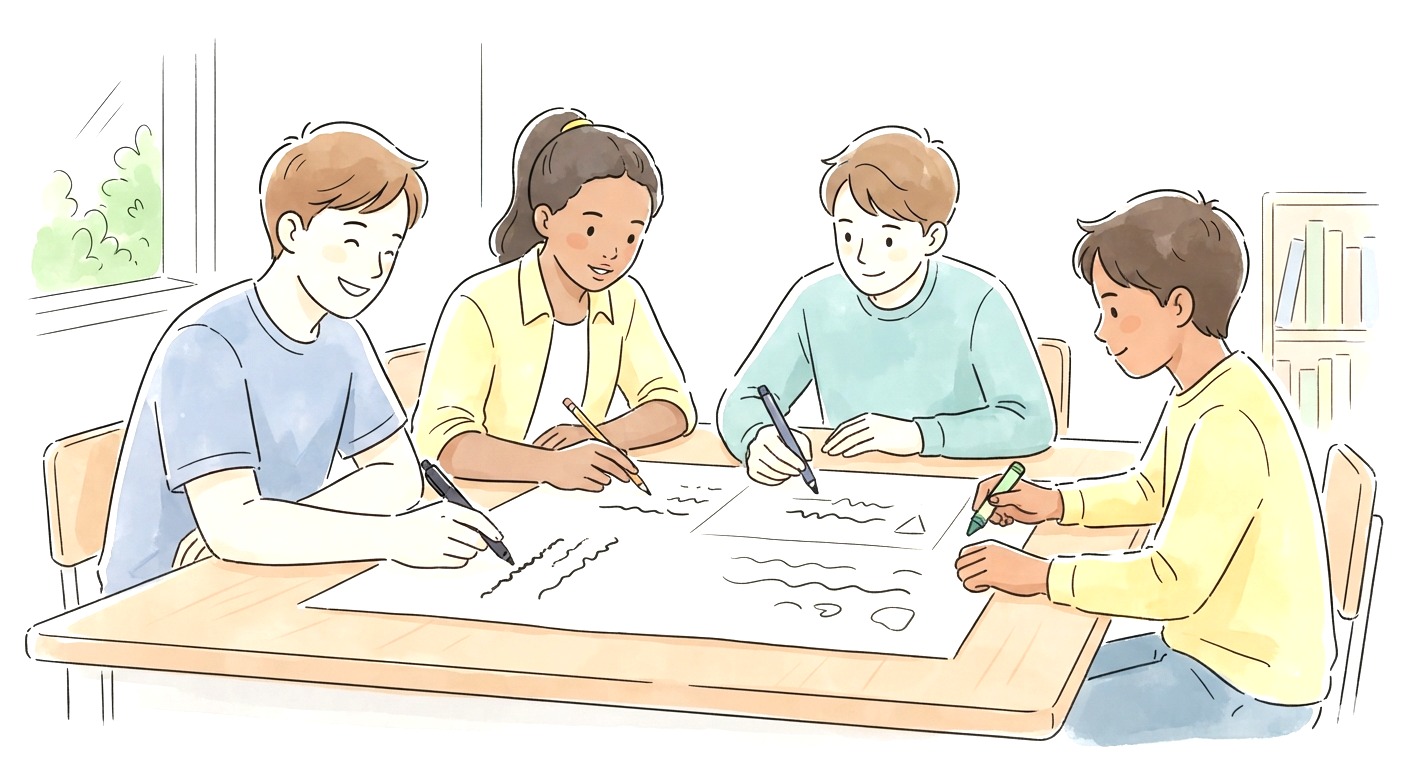
IN MY teaching experience, many students are hesitant to do writing practice. Of course, out of the four language skills, writing appears to be the most difficult among students, even though it is said that whatever we can do is not hard. Actually, writing exercises usually consume years as well as demand both accuracy and fluency in a language. Hence, in most cases, it will not be easy for a student to do writing exercises all by himself. At such times, communicative writing ideas between students come into use to a distinct extent. Although, as the saying goes, one shallow does not make a summer, more than one can make a summer. And communicative writing ideas will describe not only the concerted effort of students but also their exchange of knowledge and information.
Chain stories: In this way, each student must add a sentence to a story, then pass it on, where they can use a picture, the first line or music as a prompt. For instance, when students are asked to write an essay on the conservation of the natural environment, they can be shown one of the pictures that were awarded the Pulitzer Prize. Similarly, if students are allowed to write an essay based on a story, they can even be given a descriptive painting which portrays the story in one way or another. And language teachers can give students the first line of the subject matter, as well as its introductory sentence, as a hint. Or a piece of music can be played to students to begin any work of writing. Whatever it is, chain stories will apparently diminish such writing-related emotional or mental stress as boredom, fear and other unnecessary hesitations. Then, the final version can be edited and displayed or even work well online too.
Jigsaw writing: In this way, students must plan a longer text, no matter whether it is an essay or a report. Each of these learners has to write one part, then they will join all parts. Jigsaw writing can help students with clear organization and break writing into smaller steps. Really, this writing relies on paragraph writing, not separating a cluster of sentences. Here, jigsaw writing means partly or content-limited writing.
Hence, all paragraphs of students need be well collected without being scattered after the writing process. Actually, jigsaw writing flows well towards a lucid passage if the paragraphs must have a strong connection with each other.
Pen pals and email/letter replies: In this way, students should set up pen pals, even with other classes in the same school. In this way, they can write letters or emails and reply to each other, for example, job applications and responses. Not only that, this writing may lead to role plays, for example, a job interview. After all, students are able to make pen pals with others from different schools. In the past, people have made contact with one another by letter or email. Truly, this writing strengthens their relationships and also improves their language skills, except that they could make common or careless mistakes in the language.
The silent classroom: Silence is golden, as the proverb states. This proverb can be applied in the silent classroom for writing. In actual fact, silence refers to a passive circumstance for most students but means positive for writing classes. In this way, students have to run part of a lesson only through written communication. Students ought to use notes, mini whiteboards or online tools, such as Padlet, for example, to `talk´. This writing can reduce pressure and mirror real-life online writing.


