
By Ms Moon
LOOKING back at the history of Myanmar, the value and benefits of unity can be clearly seen. Since the era of the ancient feudal dynasties, under the united administration of competent and righteous kings, Myanmar stood firm as a unified union, extending its influence to surrounding regions. Even from those early days, in the central river valley regions where administration was centred, various ethnic nationalities, including the Bamar, Mon, and Shan, participated and gathered together to build the nation.
However, due to the bad system of divide-and-rule employed by the colonizers, differing styles of administration between the plains and the highlands, as well as discriminatory privileges, occurred as unintended consequences, causing divisions among the ethnic nationalities. Even amidst such circumstances, the great national leader, General Aung San, stated at Panglong in 1947 during the struggle for independence: "If you want the whole country to prosper, you must combine manpower, financial power, and material resources to work powerfully and forcefully. Only by working together can there be benefits." Similarly, it was precisely through the united, combined strength of the ethnic nationalities that independence was achieved.
The Strong Power of Unity and Discipline
Here, the nature of unity is also reflected in Myanmar proverbs, as the elders taught: "What cannot be achieved by the strength of one cannot be achieved by the strength of ten thousand," and "Although a single piece of firewood can be easily broken, a bundle of firewood is not easy to break." For example, if a single tree stands alone, it can be blown down by just a strong wind, but a large forest of gathered trees can withstand any rain or wind without flinching.
Therefore, in today's era, for the long-lasting stability of the nation and its modern development, the unity of ethnic nationalities has become an indispensable primary driving force. Furthermore, mere unity is not enough; there must also be strict discipline. This is because a society and a nation without discipline will never be able to progress. Thus, our sovereignty and the unity of ethnic nationalities must be carefully protected as a matter of national political responsibility.
Based on such historical lessons, in rebuilding unity firmly in the present time, it is necessary to harmoniously combine the state's guidance, the practice of the democratic system, and the mutual cooperation of the people. Therefore, the government is transparently addressing the wills and needs of the people through legitimate channels, including the parliamentary system, and the people must also march together in unity on the right path.
At the same time, taking lessons from the weaknesses and cracks encountered over many years after gaining independence, all monks, laypeople, and ethnic citizens must always hold onto the three main duties: "Preventing the disintegration of the Union, preventing the disintegration of ethnic solidarity, and perpetuating sovereignty." Only after firmly establishing unity and discipline as the fundamental foundation can the momentum of national development be driven relentlessly.
The Foretaste of Lessons from the World's Model Nations
Furthermore, the fruits of unity, discipline, and the will to work can be clearly observed and studied in some countries that stand as outstanding examples in world history. Although Japan was left in ruins after the Second World War and suffered due to the war, it rebuilt the nation with its national culture of "discipline" and the spirit of "collective gain." By prioritizing loyalty to one's job, strict discipline, and the national interest, they were able to rise from the ashes to become a top-tier global economic power in a short time.
Similarly, looking at the existence of Singapore, which in the 1960s had absolutely no natural resources and even had to buy drinking water from other countries, is astonishing. Under the leadership of Singapore's Prime Minister Lee Kuan Yew, he was able to unite diverse ethnic groups and firmly establish the pillars of rules and laws. Through the efforts of disciplined citizens, full utilization of education, and human resources, Singapore progressed to a world-class level as the financial and technological hub of Asia.
Furthermore, South Korea, which also suffered from the war, promoted the country in the 1970s based on the "Saemaul Undong" (New Village Movement) with the spirit of "diligence, self-reliance, and cooperation". Because the entire people worked together in unity and discipline with all their strength, they triumphed in culture and technology with great momentum. Putting these examples together proves that any country, if strong in discipline, unity, and attitude towards work, can reach the top
The Value of Work and The Will to Work
Therefore, to reach the status of a developed nation, in addition to unity and discipline, the "will to work" and "striving to work with all one's might" are also extremely important. According to global research, the economic and socioeconomic development of a country is directly linked to the "will to work" of its citizens.
To prove this point, Dr David McClelland's research shows that in Kakinada, India, simply conducting motivation training and awareness sessions for entrepreneurs for just 10 days resulted in an increase in their willingness to achieve. Therefore, it must be seriously noted that the will to work of humans is not just innate, but can be built by providing training, creating a good environment, and stimulating motivation.
Looking closely and carefully, although Myanmar is a country rich in above-ground and underground natural resources, it is a fact that there is still a need for a higher rate of development when compared to neighbouring countries. Therefore, it is highly necessary to fully reveal our latent physical and intellectual abilities and truly get to work.
The Ability to Work and The Desire to Work
In working, while "the ability to work" can be enhanced by thoroughly training the body to be healthy and strong, acquiring knowledge, skills, and expertise, "the desire to work" must also be cultivated with the noble consciousness of wanting to benefit one's own country and society.
In doing so, the State Government is consistently working to improve the working capacity of the people by supporting educational and vocational training, and creating opportunities for industrial and manufacturing sectors. It is only when the people seize the given opportunities and actively participate that domestic production will increase, and the country's GDP and living standards will rise higher.
Fulfilling the Duty Given by History
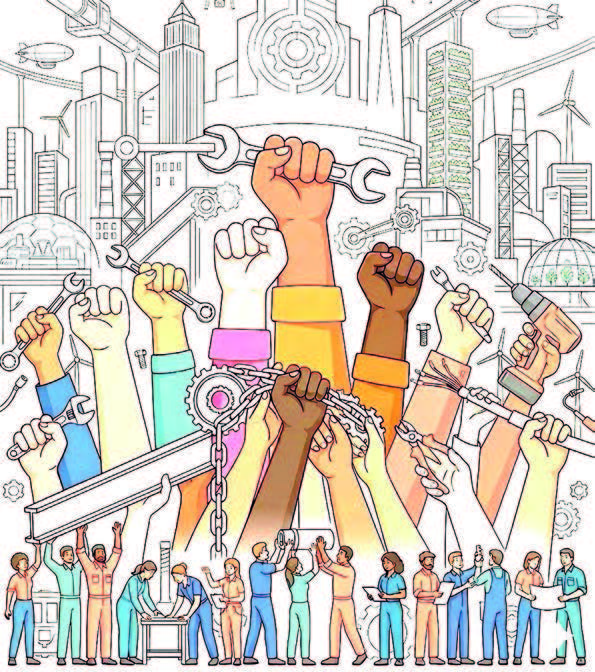
In summary, unity, discipline, and working with all one's might are three great pillars that are interconnected and cannot be separated. Only through unity can a disciplined society emerge. Only by striving to work with the vigour of a disciplined society can a prosperous and developed nation be built.
To make our motherland, the Republic of the Union of Myanmar, where we were born and raised, stand abreast with the world is a historical duty that falls on the shoulders of every citizen. If, based on the strength of unity and with strict discipline, we strive to work with all our might, the nation will surely prosper and develop. Therefore, all monks, laypeople, and citizens are urged to shape and build the motherland with benevolence, diligence, and discipline, with the call: "Let us work together in unity, discipline, and with all the strength we have."
Reference: Yadanabon Daily (25 July 2026)


