
By Dr Zaw (Sli)
Human history was not written with swords or blood, but with letters. While time may wear down stone monuments, it cannot erase the breath of literature. Just as “light” stands against darkness, “literature” stands against ignorance. Though the sun gives light to our eyes, only knowledge can give light to the human heart.
International Literacy Day: A Call to Consciousness
8 September marks International Literacy Day. This is more than a date on the calendar; it is a bell ringing to awaken human intellect, reminding us all of the importance of knowledge for dignity, freedom, and equality.
Myanmar’s Literary Heritage — A Proud Milestone in History
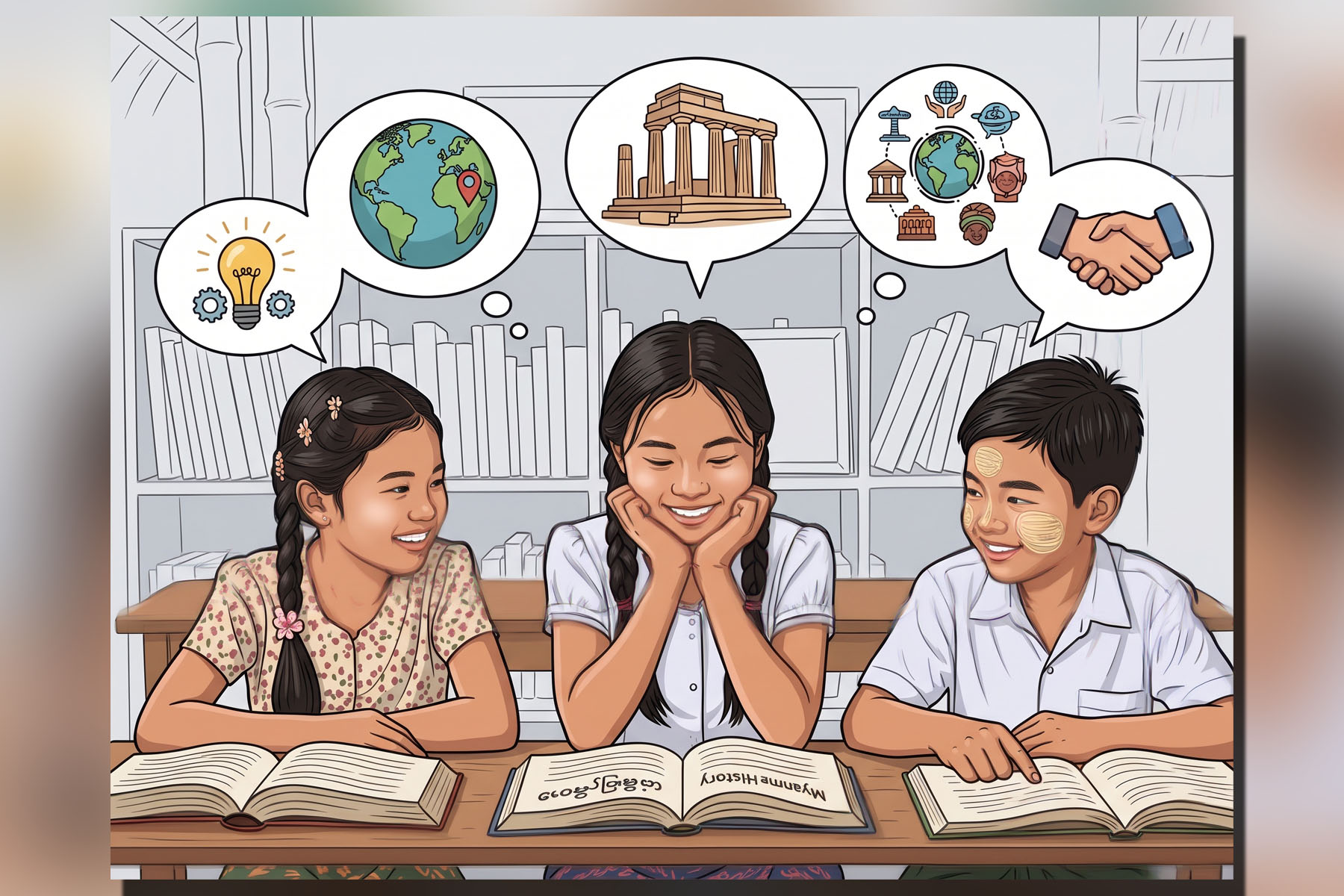
Myanmar is a land that cherishes literature. In the days of ancient kings, monastic schools were not only places of religious learning. They served as village libraries, moral education centres, and spaces where the light of life was shared. The soft voices of children sitting on wooden school floors, reciting “Ka, Kha, Ga”, learned not only letters but also the value of being human. Each letter was a seed of love, a brick of discipline, and a root of national culture. These small voices helped preserve the culture of an entire nation.
The Myanmar saying, “Education is the only lasting wealth,” captures deep wisdom in a few words. It shows that education is priceless wealth that never loses value, supporting personal growth and future success in any situation or time. Thus, treating knowledge as a treasure and pursuing continuous learning builds not only individual success but also the long-term progress of families, communities, and the nation.
The “Three Rs” (Reading, Writing, Arithmetic) campaign launched in 1964 was more than a teaching programme; it was a nationwide awakening of knowledge. During summer holidays, university students and teachers travelled to rural areas, teaching under grey thatched roofs. Teaching went beyond showing letters; when a teacher guided a learner’s hand to write a letter, it was not just fingers moving, but hope awakening. The joyful cry, “I can read now,” was not an ordinary sentence; it was the sound of human dignity reborn. Through such efforts, millions became literate.
This spirit of service was recognised beyond national borders. UNESCO awarded Myanmar the Mohammad Reza Pahlavi Prize in 1971 and the Noma Literacy Prize in 1983, honouring the country’s literacy efforts in global education history. These prizes were not only metal tokens but certificates of the world’s recognition of the people’s sincerity, love, and commitment to knowledge.
History is not only for pride; it is also a guide for the future. Today, the meaning of literacy has grown wider, yet the volunteer spirit of the past, the view of education as a national duty, and the belief that “making one person literate lifts one generation” remain a heritage that must not be lost.
60 Years of International Literacy Day
According to UNESCO records, about 739 million youth and adults worldwide still lack basic literacy skills. In 2026, International Literacy Day marks its 60th anniversary under the theme “Literacy for people, the planet and prosperity.” Spreading the light of literary knowledge to all people on Earth is a historic duty for all of modern humanity. [unesco]
Literacy should not be seen only as a government duty but as a social responsibility for all citizens. For those still without access to education, or those who left school due to economic hardship, our sympathy must turn into real opportunities. Learning begun today can rewrite tomorrow’s destiny. One of the most beautiful things in the world is when the belief “I can learn too” blossoms in a person’s heart. Illiteracy is not shameful; giving up learning is the true loss.
Many people still suffer injustice and oppression due to illiteracy and lack of knowledge. Education is the best shield and sword to overcome such difficulties. Even those who missed formal schooling can return to the regular education system through Community Learning Centres (CLC) and Non-Formal Primary and Middle Education (NFPE & NFME) pathways, rebuilding their right to education. Learning can begin again at any age, and hope can be rebuilt in any situation.
The Tears and Hopes of the Illiterate
Human tears taste the same, but their causes differ. Some cry from poverty, some from pain, and some from illiteracy. Looking closely at these tears, behind not knowing letters, we see lost opportunities, weakened confidence, and unfulfilled dreams.
For an illiterate person, the deeper pain is not being unable to read a sentence, but being unable to write their own name. When a fingerprint replaces a signature, it is no longer just a drop of ink but a silent mark of a life’s sorrow. Moments of having to ask others to read words on paper quietly hurt human dignity. What such people need is not pitying looks, but a hand of knowledge to lead them forward.
The Digital Age and the New Meaning of Knowledge
Today’s world gathers on screens the size of a palm. News can travel across the globe in seconds. Yet in this speed, a question arises: Are we people who can read news, or people who can read truth? In our time, literacy means more than reading and writing; it includes digital knowledge, the ability to critically judge information, and the ethical use of technology.
A literate person today is not a fast reader but a deep thinker; not a quick sharer of news but one who can verify truth. Using devices correctly with wise knowledge matters more than simply knowing how to use them.
Everyone’s Duty — One Book, One Knowledge, One Future
Literacy is not only a government duty but a social responsibility for all. On this International Literacy Day, respect and gratitude are offered to teachers, volunteers, librarians, and all who pass knowledge to new generations around the world.
To those still unable to read, to children outside school, and to youth far from educational rights: You are not left behind; you are waiting for hope. Life may have kept some far from school gates, but a person’s life is not defined only by the past. Learning begun today can rewrite tomorrow’s fate. One of the most beautiful things is not a flower blooming, but the belief “I can learn too” blossoming in a person’s heart. There is no “too late” in learning. As a flower blooming in the morning is beautiful, so is one blooming in the evening. What matters is that it blooms. Likewise, as long as a person can accept knowledge at any time in life, their future remains alive.
Let parents pass on the love of reading to new generations. Let communities create more libraries, reading clubs, and learning opportunities. Giving a book is giving knowledge, and giving knowledge is building a future.
Passing On the Light of Knowledge Forever
Time waits for no one. Seasons change, and so do eras. Yet one thing remains unchanged in every time, place, and people: the value of knowledge. Literacy is not only reading letters; it is a key to opening the human mind, courage to face life’s difficulties, and wisdom to tell right from wrong.
Sharing a book, reading to a child, teaching a letter to someone who cannot read; these may seem small acts, but they are seeds that can change humanity’s future. Literacy is not only an education programme; it is humanity’s eternal pillar of light. Literature lifts the person, education lifts the nation, knowledge brings peace to the world. One person can change a community, a community can lift a nation, and the combined knowledge of nations can build a peaceful and just world.
Therefore, let us pass on the light that begins with opening a book from generation to generation. Let us work together so that the lamps of knowledge never go out but shine forever.


