
Teachers must nurture students into competent and virtuous individuals who contribute to national development and foster the spirit of Union.
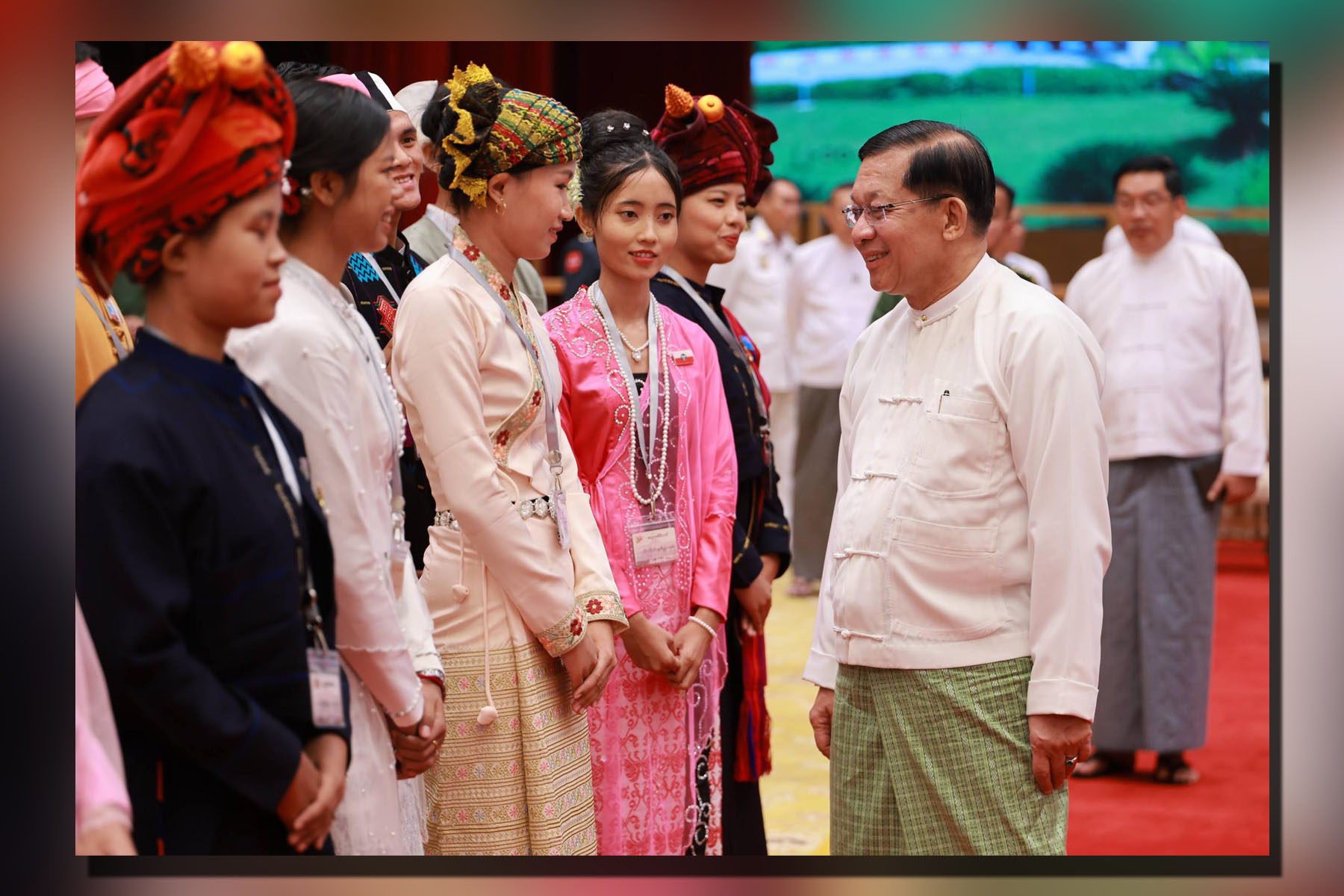
President of the Republic of the Union of Myanmar U Min Aung Hlaing urged future teachers to nurture qualified young people, promote national unity and contribute to the country’s development during a guidance ceremony for students from the eighth intake of the five-year Education Degree Course at the University for the Development of the National Races of the Union. The ceremony was held at the Ngu Shwe Wah Hall of the Presidential Residence yesterday afternoon.
The ceremony was attended by Vice-Presidents U Nyo Saw and Nan Ni Ni Aye, Commander-in-Chief of Defence Services General Ye Win Oo, Union ministers, senior Tatmadaw officers from the Office of the Commander-in-Chief, the Nay Pyi Taw Council chair, the commander of the Nay Pyi Taw Command, deputy ministers and officials, as well as the university’s rector, teachers and students.
In his guidance address, the President recalled that the Institute for the Development of the National Races was established on 20 October 1964 to produce qualified education personnel capable of promoting national unity and the socioeconomic development of ethnic nationalities. It was upgraded to university status on 10 May 1991. To date, the university has produced 14,698 teachers.
He said the students would soon graduate and begin serving the country, urging them to apply their knowledge and skills to shaping the futures of young people in their assigned areas. Teachers must recognize that their responsibilities extend beyond classroom instruction to developing students’ attitudes, moral character and life goals. He compared teachers to potters who mould clay, emphasizing their role in shaping the next generation.
Education, he said, is fundamental to both individual advancement and the development of society. An educated population is essential for achieving sustainable progress in the economic, social, health and technological sectors.
The President highlighted the Government’s education spending plans for the 2026-2027 financial year, stating that 6.92 per cent of the State budget had been allocated to the Ministry of Education. Including education expenditure by other ministries, the figure reached 9.22 per cent. Plans were in place to increase education spending to at least 10 per cent in the next financial year, 15 per cent in the following year and ultimately 20 per cent during the Government’s term of office.
He also outlined efforts to ensure that all school-age children attend school, while providing further educational opportunities for middle-school graduates through high schools specializing in industrial, agricultural and livestock-breeding subjects. Vocational education and pathways to university are being made available to qualified students. Non-formal education programmes are also being implemented to help young people who have left school for various reasons resume their studies.
The President urged the future teachers to ensure that children in their assigned areas have access to education, encourage those who have dropped out to return to school and secure greater participation from parents and local communities.
Emphasizing the importance of teaching quality, he said that well-qualified teachers were essential to building a high-standard education system. Teachers should continuously improve their knowledge and teaching skills rather than rely solely on rote memorization. They should encourage students to develop critical thinking, analytical abilities and creativity, while linking classroom lessons to practical situations so that students can apply their knowledge in everyday life.
Schools also play a vital role in developing disciplined and responsible citizens. As role models, teachers must be mindful of their words, behaviour and moral conduct, while treating all students fairly and demonstrating honesty, integrity and goodwill.
Turning to national unity, the President noted that Myanmar’s diverse ethnic nationalities, languages and cultures enrich the country’s cultural heritage. He stressed the importance of fostering mutual understanding, respect, trust and unity among ethnic communities.
He explained that Union spirit involves loving one’s own ethnicity, language and culture while respecting and valuing the traditions and cultures of other ethnic groups. Cooperation for the common good further strengthens this spirit. Having studied together for five years, the students had developed friendships and learned to embrace Union spirit. He encouraged them to set an example in their assigned areas by promoting friendship, mutual understanding and unity among ethnic communities.
The President also underscored the importance of developing young people, describing them as the next generation who would shoulder national responsibilities. According to the 2024 Population and Housing Census, people aged 15 to 24 account for more than 16 per cent of the country’s population.
He urged the future teachers to identify and nurture talented young people in their respective areas, helping them develop not only knowledge, practical skills and moral character but also physical fitness, mental resilience and social skills. Teachers should encourage young people to set goals, work diligently towards their ambitions and become responsible individuals who contribute to their families, communities and society.
As the students would soon enter public service, the President stressed the need for them to understand and comply with relevant laws, rules, regulations and professional ethics. Good civil servants must demonstrate competence, responsibility, honesty, integrity and commitment to the public. In line with the principle that “good civil servants make a good nation”, they should perform their duties with dedication, enthusiasm and self-sacrifice. Teachers, in particular, must maintain the trust and respect of students and parents.
He further urged the students to nurture their pupils into capable and virtuous individuals possessing the five strengths: physical, intellectual, moral, social and economic. They should uphold the five duties of teachers and guide students to distinguish right from wrong and respect social ethics. Respect for ethnic traditions and cultural heritage must also be encouraged to strengthen friendship, unity and Union spirit.
Concluding his address, the President called on the future teachers to uphold the Our Three Main National Causes, apply their professional teaching skills and serve the interests of the State and the people. He urged them to fulfil their assigned responsibilities faithfully and with wholehearted dedication, expressing his wish that they would become worthy citizens upon whom the nation could rely.
On behalf of the students from the eighth intake, Ma May Thwe Phoo, an ethnic Shan student from Hsihseng Township in the Pa-O Self-Administered Zone of Shan State (South), delivered a speech of thanks.
Two students then presented commemorative gifts to the President. Following the ceremony, the President, attendees and students posed for a group photograph, after which he met the students individually, spoke with them and offered words of encouragement. — MNA/ ST


